Guide · AI Strategy
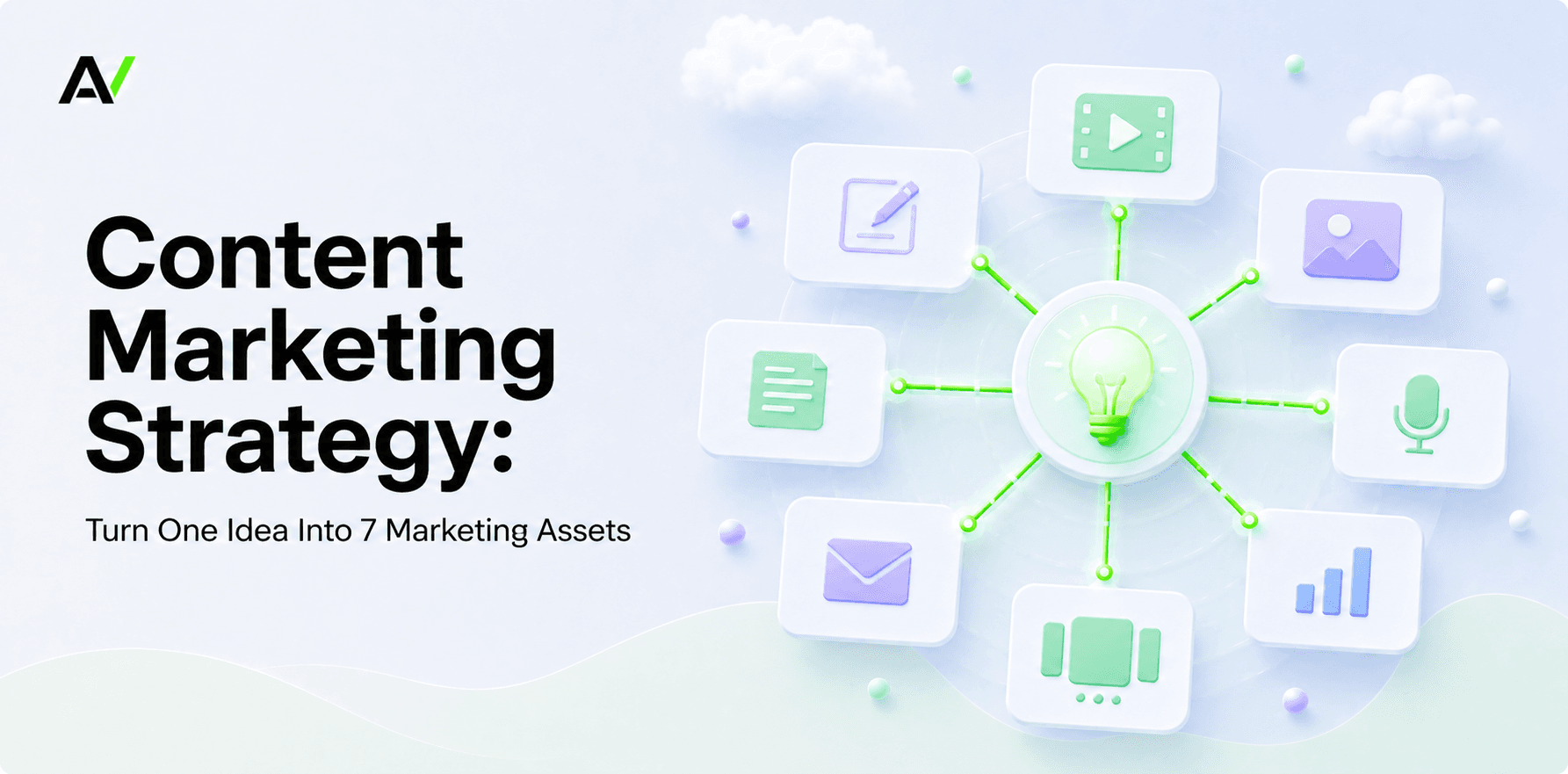
Content Marketing Strategy: Turn One Idea Into 7 Marketing Assets
Learn how to turn one strong idea into seven channel-specific marketing assets, distribute them effectively, and generate leads with a lean content team.
January 30, 2026 · 12 min read
On this page
Article · AI Strategy
Turn one high-value idea into channel-specific assets while preserving message consistency.
The math of small-team content works only one way: most of what you publish must be an adaptation of something you have already created. Producing seven original assets every week can exhaust a lean marketing team. Creating one strong source asset and deriving seven channel-specific assets from it can become a repeatable Tuesday workflow.
But effective content repurposing is not copying the same paragraph into five platforms. That approach produces five weak posts, ignores how people use each channel, and trains audiences to scroll past your message.
A better content marketing strategy starts with one valuable idea, develops it into a deep source asset, and then adapts its strongest parts into seven native formats. The central argument remains consistent, but the hook, structure, depth, and call to action change for each audience and platform.
This guide explains how to build that system, distribute the assets, measure their performance, and turn repurposed content into qualified leads.
What Is a Content Marketing Strategy?
A content marketing strategy is a documented plan for using useful, relevant content to attract a defined audience and move that audience toward a business outcome. It connects what you publish with four practical decisions:
- Who the content is for
- Which problem or question it addresses
- Where and how the audience will discover it
- What the audience should understand or do next
A content calendar tells you when to publish. A content marketing strategy explains why the content should exist in the first place.
For a small team, the strategy must also account for production capacity. A plan that requires five entirely original ideas, multiple videos, a newsletter, and a long-form article every week may look impressive but rarely survives contact with real workloads. Sustainable content operations begin with fewer, stronger ideas and a deliberate content repurposing workflow.
The goal is not to publish more for the sake of activity. It is to make each valuable idea work harder across search, social media, email, sales, and customer education.
Start with an idea worth expanding
Not every idea deserves seven marketing assets. The repurposing funnel is most effective when the source idea clears three tests:
- It answers a real buyer question. The topic should come from observable demand, such as sales conversations, support tickets, search queries, community discussions, competitor gaps, or website audit findings.
- You have something specific to contribute. Strong content contains evidence, experience, examples, a useful framework, or a clear position. A generic summary gives downstream assets nothing memorable to carry.
- It connects to the business. The idea should lead naturally toward a product, service, method, audit, consultation, or next step without turning the entire piece into a sales pitch.
One qualified idea per week can be enough. This turns idea scarcity from a crisis into a useful filter: instead of asking, “What can we post today?” the team asks, “Which customer question deserves our best answer?”
Why Content Repurposing Matters
Content repurposing is the process of transforming one source asset into multiple formats for different platforms, audiences, or stages of the buyer journey. Done well, it improves efficiency without sacrificing relevance.
The value goes beyond saving time.
It creates message consistency
When every asset begins with the same source argument, the brand is less likely to contradict itself across channels. The language can change, but the core message, evidence, and positioning remain aligned.
It increases the return on research
Research is often the most expensive part of content creation. Interviews, audits, source reviews, examples, and original analysis should not disappear after one blog post. Repurposing spreads that investment across several discovery surfaces.
It reaches people in the format they prefer
One buyer may search Google for a detailed guide. Another may discover the idea through a LinkedIn post, an Instagram carousel, or a short video. A third may need the same explanation in an email from a salesperson. Multiple formats create more entry points into the same expertise.
It supports both SEO and AI visibility
A deep, well-structured source article can target search demand and provide clear, citation-friendly answers for AI systems. Supporting social posts, newsletters, FAQs, and expert commentary can reinforce the topic across the wider digital footprint. Content repurposing therefore helps a brand become not only more active, but also more understandable and consistently associated with its subject.
It extends the lifespan of a strong idea
Publishing everything at once creates a brief spike. A sequenced rollout can create two or more weeks of visibility from one week of research and thinking. That is the economic advantage of a repurposing system.
How to Turn One Idea Into Seven Marketing Assets
The workflow begins with a deep source asset, usually a long-form article, research guide, webinar, podcast episode, report, or customer case study. This is where the complete thinking belongs: the argument, evidence, examples, objections, framework, and direct answers.
Write the source asset with extraction in mind. Include clear section claims that can stand alone, a quotable definition, a list that can become a carousel, a counterintuitive observation that can open a thread, and direct questions that can become an FAQ.
If a long-form piece contains no extractable parts, the problem is usually not the repurposing process. It is a sign that the original argument needs more clarity or substance.
From that source, create these seven derivative assets.
1. LinkedIn post
Compress the central argument into its professional or commercial consequence. Open with a recognizable problem, show why the usual approach fails, present the insight, and end with a question or a relevant next step.
For example, an article about content repurposing could become a LinkedIn post about why small marketing teams burn out when every channel has a separate production process.
2. X thread
Use the framework, strongest claim, or most contrarian observation. Give each post one job: create tension, explain a step, present evidence, or move the reader toward the conclusion. Do not divide the article mechanically by paragraph. Rebuild the idea for momentum.
3. Instagram or LinkedIn carousel
Convert the process, checklist, comparison, or sequence into a visual narrative. One slide should communicate one clear point. The cover creates curiosity, the middle slides teach, and the final slide provides a useful conclusion or call to action.
A carousel based on this article might use the sequence: one buyer question, one deep article, seven assets, one connected campaign.
4. Short-form video script
Choose the single point people are most likely to misunderstand. Lead with the misconception, explain the correction quickly, and give one practical example. A 30- to 60-second video should not attempt to summarize the entire source article.
A native opening might be: “Repurposing content does not mean posting the same caption everywhere. It means keeping the argument and changing the doorway.”
5. Newsletter section
Add the context you would give a colleague: why the idea matters now, what triggered it, and what the reader can apply this week. The newsletter can summarize the lesson while linking to the source asset for the full framework.
6. Website FAQ block
Extract two or three buyer questions and answer them directly. Use plain language, specific information, and a logical heading structure. This gives visitors faster answers and creates structured, retrieval-friendly content that search engines and AI answer systems can more easily interpret.
Examples include:
- What is content repurposing?
- How many assets can you create from one blog post?
- Should the same content be posted on every social media platform?
7. Sales or onboarding snippet
Turn the idea into the version a founder, salesperson, or customer-success manager can send when a prospect or customer asks the same question. This could be a short email paragraph, a one-page explanation, a saved response, or a link with context.
This seventh asset is frequently overlooked. If content answers a real buyer question, it belongs in the sales and customer journey-not only in the public feed.
The Content Marketing Funnel Explained
The repurposing funnel is not simply a diagram that moves one article into smaller formats. It is a content operating system with four stages:
1. Research
Find a question with evidence of demand. Useful sources include keyword data, customer interviews, sales objections, website analytics, competitor coverage, online communities, and SEO or AEO audit findings.
2. Develop
Build the complete source asset. Validate the claim, organize the evidence, answer likely objections, and connect the subject to the buyer’s next decision.
3. Adapt
Extract the strongest components and rebuild them for each channel. The thesis stays constant, but every asset receives a platform-specific hook, format, level of detail, and call to action.
4. Learn
Track performance as one campaign rather than seven unrelated posts. Identify which hooks attracted attention, which formats drove meaningful engagement, which questions generated conversations, and which assets influenced qualified actions. Feed those findings into the next source asset.
This creates a compounding loop:
Customer signal → source content → channel-specific assets → performance data → stronger customer insight
AI can accelerate the adaptation stage. Given a reliable source asset, brand context, audience, and platform requirements, an AI system can generate first drafts for multiple channels. Human review is still essential: someone must verify that the claim survived the translation, the tone fits the brand, and the asset makes sense on the platform.
How to Distribute Repurposed Content
Do not publish all seven assets on the same afternoon. A content distribution strategy should sequence the campaign so each derivative creates a new opportunity for discovery.
A simple two-week rollout could look like this:
- Day 1: Publish the long-form source asset on the website.
- Day 2: Share the highest-reach LinkedIn post with a link or contextual call to action.
- Day 4: Publish the carousel using the most visual framework from the article.
- Day 6: Send the newsletter section with a reason to read the full guide.
- Day 8: Publish the short-form video around the strongest misconception.
- Day 10: Release the X thread using the argument with the most tension.
- Day 12: Add the FAQ block to the relevant website page.
- Ongoing: Place the sales or onboarding snippet in the team’s response library.
The sequence should match the behavior of your actual audience. If video consistently creates initial discovery, publish the video earlier. If the newsletter drives the most qualified traffic, use it to introduce the source piece. Distribution is not a fixed template; it is a hypothesis improved by performance data.
Keep the content family connected operationally. Give the source asset and derivatives a shared campaign name, link every child asset to its parent, record its target audience and channel, and keep approval status and publishing dates in one workspace. This lets the team see what shipped, what stalled, and how one idea performed across the full system.
In an ActVox workspace, the source material, channel drafts, brand context, and content calendar can remain part of the same workflow. A shared project board and consistent naming convention can also work-the important part is preserving the relationship between the assets.
How Repurposed Content Generates Leads
Repurposed content generates leads when each asset creates a sensible next step for the reader’s level of intent. Not every post should ask for a demo.
At the top of the funnel, a carousel or short video may aim for recognition, saves, or profile visits. A LinkedIn post or thread can move an interested reader toward the full article. The article can lead to a template, audit, newsletter, diagnostic, or relevant product page. A sales snippet can help a qualified prospect make a decision.
The path might look like this:
Short video → source article → free audit → qualified conversation
Or it may be less direct:
LinkedIn post → newsletter subscription → repeated exposure → sales inquiry
Measure the content family across three levels:
- Attention: reach, impressions, video completion, and search visibility
- Engagement: saves, shares, replies, time on page, and newsletter clicks
- Business action: audit starts, sign-ups, qualified visits, assisted conversions, and sales conversations
Avoid judging every asset by last-click conversions. A carousel may introduce the idea, a newsletter may build trust, and the source article may provide the proof that finally moves a buyer. Use campaign links, conversion events, CRM notes, and self-reported attribution to understand the combined effect.
The most useful question is not, “Which post won?” It is, “Which idea created movement across the customer journey?”
Content Marketing Repurposing Checklist
Use this checklist before turning one idea into multiple marketing assets.
Source idea
- Does the idea answer a question real buyers ask?
- Is there evidence, experience, or a clear point of view behind it?
- Does it connect naturally to a business goal or offer?
Source asset
- Does it contain a complete argument rather than generic commentary?
- Are the main sections clear enough to stand alone?
- Does it include examples, direct answers, and a practical framework?
- Are factual claims verified and sources recorded?
Channel adaptation
- Does each asset use a platform-native opening?
- Is the central thesis consistent across every version?
- Is the length and structure appropriate for the channel?
- Does each asset offer a relevant next step?
- Has a human reviewed AI-generated adaptations for accuracy and brand fit?
Distribution
- Are the assets scheduled as a sequence rather than a single content dump?
- Are the source and derivative assets grouped under one campaign?
- Can the team see ownership, review status, and publishing dates?
- Are evergreen FAQ and sales assets stored where people will actually use them?
Measurement
- Are attention, engagement, and business actions tracked separately?
- Can performance be evaluated at the campaign level?
- Are winning hooks, questions, and formats feeding the next source idea?
Know when not to repurpose
The funnel is built for substantial ideas, and not every piece of content is one. Timely reactions, community replies, cultural moments, and platform-native experiments may deserve to begin and end on their original channel.
The workflow can also run in reverse. If a short post or spontaneous thread performs unusually well, treat that response as market evidence. The audience may be telling you which idea deserves a deeper article, guide, webinar, or campaign next.
A content repurposing system should create leverage, not become a cage. Its purpose is to help your best thinking appear wherever buyers discover, evaluate, and discuss your brand-without forcing your team to recreate the work every time.
Put This to Work for Your Business
The strongest content marketing strategy begins with evidence from your real digital footprint: the questions your audience asks, the pages competitors use to win visibility, the topics your website is missing, and the content formats most likely to support the buyer journey.
For a business-specific version of this framework, run a free ActVox audit and receive an actionable plan based on your website, search visibility, AI search readiness, competitors, social presence, and content gaps.
In ActVoxFounder-led content and feature-release workflows for SaaS
Next step
Put this to work on your business
For a business-specific version of this framework, run a free audit and get an actionable plan built from your real digital footprint.
Start my free auditRelated · Same topic
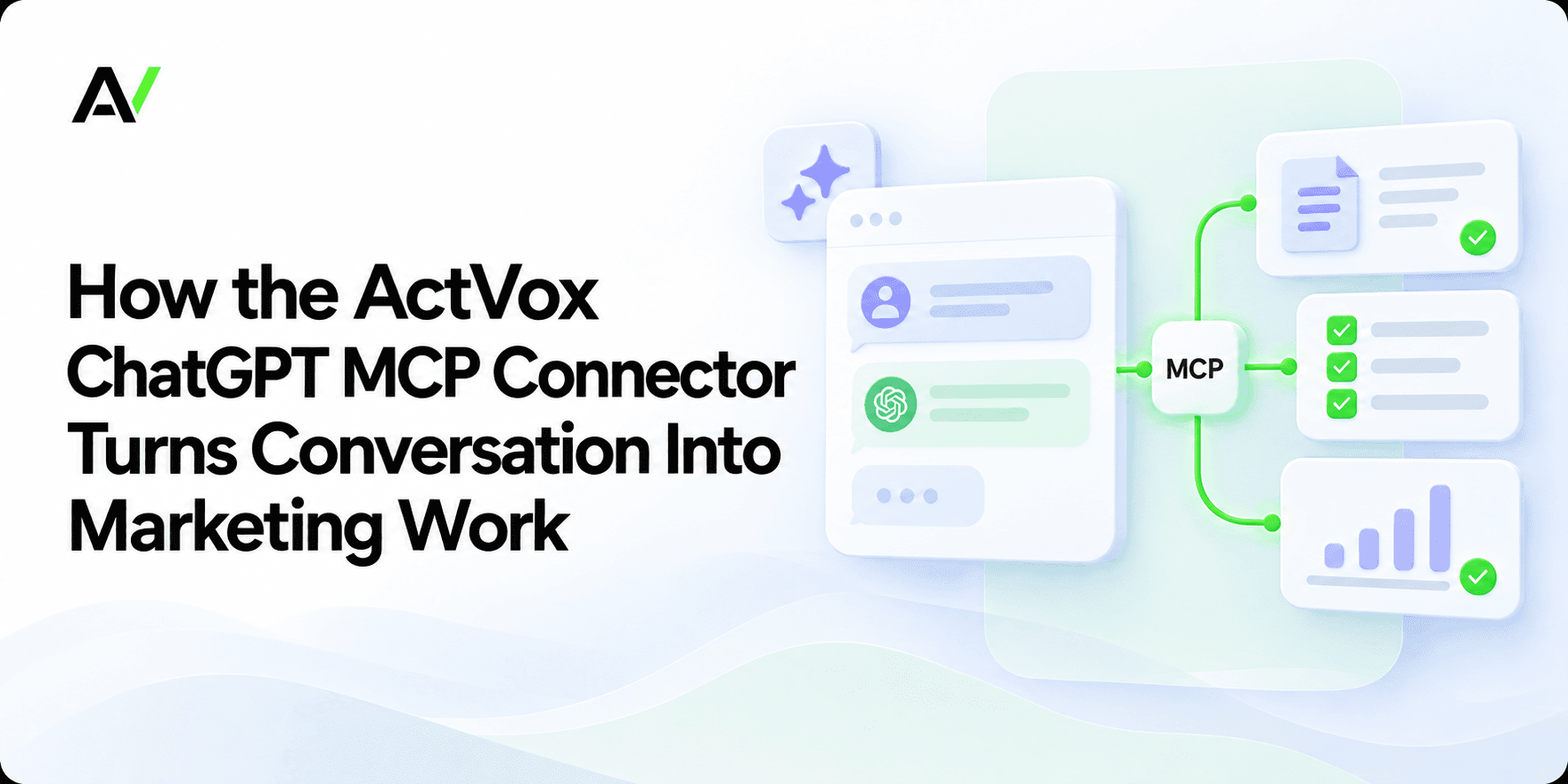
How the ActVox ChatGPT MCP Connector Turns Conversation Into Marketing Work
A connected workflow for moving from a ChatGPT question to grounded, reviewable work in ActVox.
Best AI Marketing Tools for Small Businesses
A practical guide to choosing AI tools for strategy, SEO, content, social media, CRM, and automation.
Marketing in the Age of AI: How the Marketer Role Is Changing
AI is changing marketing from asset production to evidence, judgment and connected execution. Learn the skills and systems that matter now.