Guide · SEO/GEO
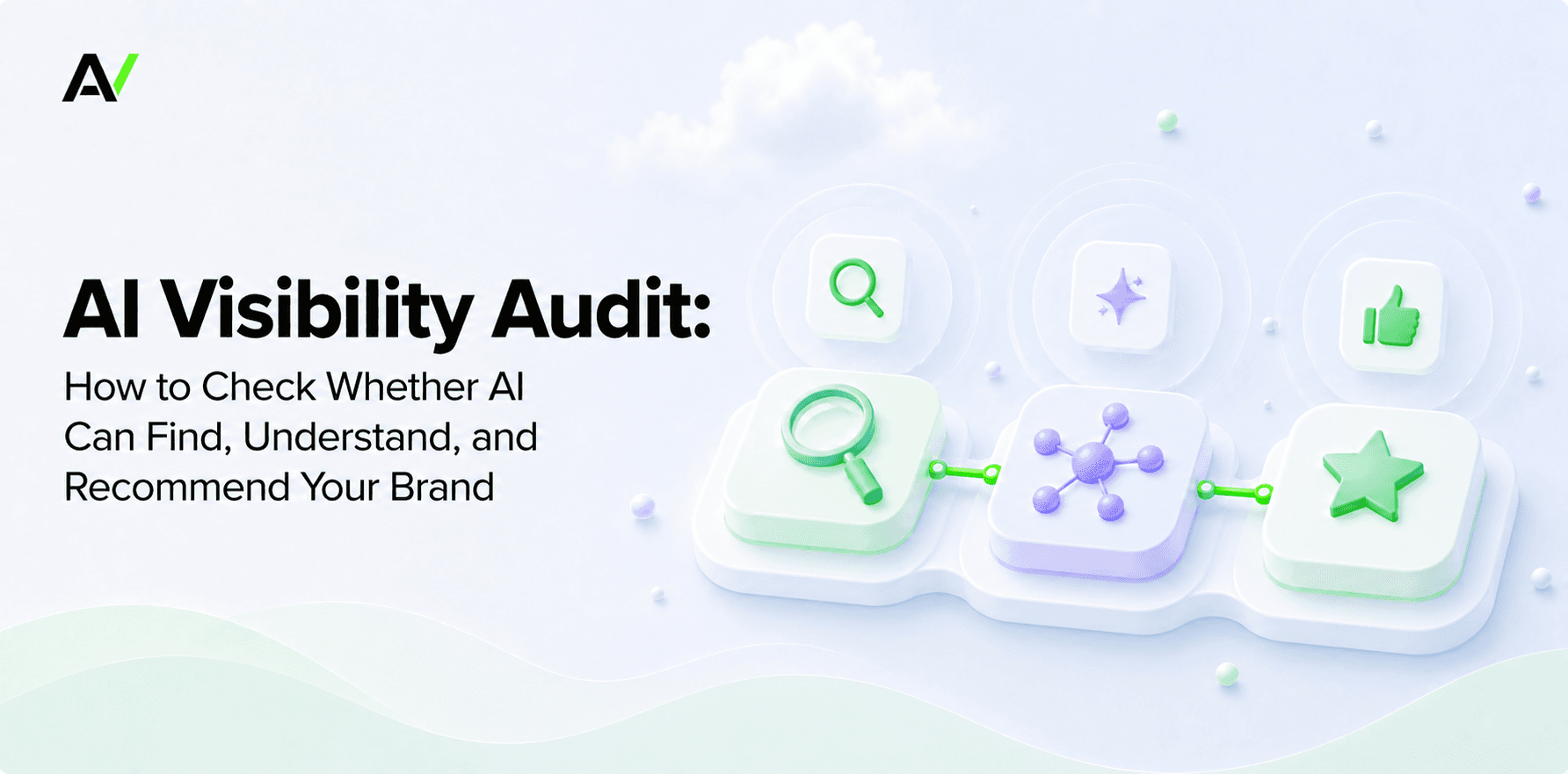
AI Visibility Audit: A Practical Checklist and Example
A structured analysis of how easily your business can be found, understood, trusted, cited, and recommended across search engines and AI answer engines.
July 21, 2026 · 15 min readBy ActVox editorial team · Edited by ActVox editorial team · Reviewed September 9, 2026
On this page
Article · SEO/GEO
Search visibility used to mean one main question: where does a website rank when someone enters a keyword into Google? Rankings still matter. But buyers now research through more than a list of links. They ask ChatGPT, Perplexity, Gemini, Copilot, and AI-powered search experiences to explain categories, compare options, shortlist providers, and recommend next steps.
Sometimes that AI answer is the first version of your brand story a prospective buyer sees. It may be accurate and useful. It may be vague, outdated, or confused with a competitor. It may omit your brand entirely from a high-intent conversation. That creates a new marketing responsibility: understand whether AI-mediated discovery helps buyers find, understand, and trust the right story about your company.
An AI visibility audit is a structured review of how a brand appears in those moments. It is not a hunt for a single score, and it is not an attempt to manipulate an answer engine. Its purpose is to identify what a buyer can learn about your business, what they cannot learn, where information is weak or misleading, and what action will make the public evidence around your brand clearer.
What an AI visibility audit should answer
A useful audit starts with the buyer, not with a model. Random prompts such as “Tell me about our company” can surface basic factual errors, but they rarely reveal whether a brand is present when a real purchase decision begins.
Start by mapping questions across the buyer journey. At the awareness stage, buyers ask what a category is, what problem it solves, or which approach makes sense. During consideration, they ask which providers serve an audience, what capabilities matter, or how two approaches compare. Near a decision, they may ask about fit, evidence, implementation, risks, price models, or the best next step for their specific situation.
Then test four things.
- Coverage. Does the brand appear in relevant category, problem, use-case, and comparison conversations? Presence alone is not enough, but absence from high-intent questions is an important signal.
- Accuracy. When the brand appears, is it described correctly? Does the answer reflect the right audience, problem, offer, differentiation, and boundaries? A false or vague description can be worse than no mention.
- Evidence. What sources support the answer? Are there clear first-party pages, credible third-party references, useful educational resources, and proof that a buyer can inspect?
- Decision gaps. What is missing, unclear, contested, or weak? The valuable output is not “our score is low.” It is a diagnosis of why a prospective buyer cannot find, understand, or trust the right story.
A practical AI visibility audit process
A repeatable audit is a small research protocol. Define the questions, platforms, dates, and evidence fields before you open an answer engine. This keeps an interesting response from turning into an unsupported conclusion.
- Choose five to ten buyer questions across awareness, consideration, comparison, and decision intent. Include direct brand questions, but do not make every prompt about your brand.
- Run the same neutral wording on the platforms that matter to your audience. Record the platform, search mode, location if relevant, date, and the exact prompt.
- Save the complete answer and every visible citation. Mark whether the brand is absent, mentioned, recommended, or described inaccurately; do not rely on memory or a cropped excerpt.
- Open the supporting sources and compare them with the answer. Separate what you observed from what you think should change, and record uncertainty where a source or response cannot be verified.
- Prioritize the gaps closest to a buyer decision. Give each action an owner, a source or page to improve, and a retest condition rather than promising a ranking or recommendation outcome.
Keep the protocol stable for the next review. AI responses vary by platform, account context, location, retrieval settings, and time. A dated observation is useful because it can be compared with another dated observation; it is not a permanent market truth.
Copyable checklist
Copy this checklist into a research note or workspace page before starting. The boxes are prompts for evidence collection, not claims that a test has already been completed.
- Define the audience, market, category, and buyer decision you are testing.
- Write the exact buyer question and keep neutral wording where possible.
- Record the platform, search mode, location, account context, and date checked.
- Save the complete answer, not only the sentence that mentions your brand.
- Mark presence, prominence, accuracy, recommendation, and competitor framing.
- Capture every cited or linked source and check whether each source is public and relevant.
- Separate an observed finding from a proposed content, positioning, or technical change.
- Name the gap, owner, priority, retest date, and limitation of the observation.
Record the evidence in a working table
One row should answer one buyer question. Use the table to preserve provenance from prompt to action. The rows below are illustrative examples only: they are not a live ActVox result, a customer outcome, or evidence that an answer engine returned the stated text.
| Buyer question | Platform and date checked | Observation | Supporting source | Gap | Recommended action |
|---|---|---|---|---|---|
| What should a small team look for in an AI marketing operating system? | Illustrative answer engine · record the date | Illustrative observation: the answer explains the category but omits the brand. | Record the cited URLs here; this illustrative row has no live source. | Category definition and discoverability gap. | Publish a concise category page with evidence and link to it from related guides. |
| What does this company do, who is it for, and how is it different? | Illustrative answer engine · record the date | Illustrative observation: the brand is mentioned, but the audience or offer is vague. | Compare the answer with the approved first-party positioning page. | Positioning clarity gap. | Align the homepage and use-case page, then retest the same direct prompt. |
Worked example (illustrative)
Imagine a team tests a neutral category question and does not see its brand in the response. That observation alone does not prove that the brand is invisible everywhere. The team should preserve the exact prompt, answer, platform, date, and sources before deciding what to do.
- Observed finding (illustrative): the answer describes the category, but the team is absent from the shortlist.
- Evidence to retain: the verbatim answer, platform and date, the prompt, cited URLs, and the page or profile information available at the time.
- Proposed change: improve one authoritative category or use-case page so it states the audience, problem, mechanism, proof, and boundaries in plain language.
- Retest condition: repeat the same prompt after the source material has had time to be discovered, then compare the dated responses without treating one changed answer as proof of causation.
The distinction matters. The first line is an observation from a defined test. The third line is a proposed change. Neither is a measured ranking improvement, customer result, testimonial, or promise of recommendation. No approved annotated customer report screenshot is available in this repository, so this article uses a text-only illustrative example instead of presenting an invented product screen as real.
Build the audit around real buyer questions
The fastest way to make an audit useless is to use generic prompts or to ask questions that already contain the desired answer. Build a question set from actual customer language instead. Use sales calls, customer interviews, website-search data, support conversations, competitor comparison pages, community discussions, and the questions a prospect asks before they agree to a demo.
Group the questions by intent. A B2B company may test category questions, problem questions, use-case questions, comparison questions, objection questions, and direct brand questions. Keep category and comparison prompts neutral wherever possible. “What are the best approaches for building a source-backed marketing plan?” reveals more than “Why is our product the best?” A neutral question shows whether a brand earns a place in the conversation without being inserted by name.
Maintain a second set of direct brand prompts. These test whether the information already available accurately reflects the company’s positioning. Ask what the business does, who it is for, what problem it addresses, how it differs from alternatives, and what evidence supports important claims. Record the full answer, not merely whether your company name appears.
The audit should be repeatable. Save the prompt, platform, date, exact response, visible sources or citations, brand mention, factual accuracy, and a short assessment. AI responses can vary by platform and change over time. One response is an observation, not a permanent verdict.
Evaluate visibility without confusing it with ranking
AI visibility does not replace technical SEO, content performance, or traditional search metrics. It is another evidence surface. Search data can show impressions, rankings, clicks, and query demand. AI visibility review can show whether a buyer receives an understandable synthesis of the information that exists across the web. The two overlap, but they are not the same.
Avoid reducing the audit to a simplistic percentage. A brand might appear in ten low-value prompts but be absent from three high-intent comparison questions. That is a serious commercial gap. Another brand may be mentioned rarely, but accurately cited for a valuable and specific use case. The quality and relevance of the appearance matter more than the count alone.
Prioritise findings according to buyer intent and business relevance. A practical framework uses four outcomes:
- Protect: The brand is present and correctly explained. Preserve the source material and monitor for changes.
- Clarify: The brand appears, but positioning is vague, incomplete, or easily confused with a competitor.
- Correct: The answer contains a material factual error, an outdated description, or an unsupported comparison.
- Build: The buyer question is strategically important, but the market lacks useful and credible information that addresses it.
This turns an audit into a marketing work plan rather than a report full of screenshots.
Check the information behind the answer
A model cannot consistently explain what the market cannot clearly find. The audit should therefore move beyond outputs and examine the information available to both buyers and search systems.
Start with your own website. Can a new visitor quickly understand the audience, problem, mechanism, proof, and next step? Are core pages specific, or do they rely on broad phrases such as “AI-powered,” “all-in-one,” or “innovative platform”? Does the category page explain the customer job in language buyers use? Do use-case pages show a recognisable trigger, a working approach, and a concrete outcome?
Next, review evidence. Important claims need a clear home. If you say a product helps teams make better decisions, can a reader see how? If you claim a specific use case, is there an educational guide, product explanation, example, or approved customer proof behind it? If the evidence is missing, the answer is not to repeat the claim more often. It is to create material that earns the claim.
Third-party sources matter too, but they are not a shortcut around weak positioning. Credible editorial coverage, partner references, founder expertise, reviews, public talks, and independently useful resources can expand the evidence base. The standard is accuracy and relevance, not the raw number of mentions.
Find gaps that change marketing decisions
Most visibility gaps fall into five categories.
A positioning gap occurs when a company is mentioned but the market cannot tell what it is distinctively for. Generic language or an unclear category story often creates this problem.
A proof gap occurs when an important claim lacks supporting evidence. The site may state a benefit, but there is no helpful explanation, example, source, or customer validation behind it.
A content gap occurs when buyers ask a high-intent question and there is no strong page or resource that answers it. This is not an invitation to publish dozens of shallow articles. It is a reason to create one useful, specific asset.
A comparison gap occurs when competitors define the category, or buyers cannot understand the trade-offs between approaches. The response is not attack copy. It is clear category education, honest boundaries, and language that helps a buyer make a better choice.
A freshness gap occurs when public information no longer reflects the offer, audience, or point of view. Old pages, abandoned messaging, inconsistent descriptions, and stale profiles can all create confusion.
For each gap, document the likely cause, evidence supporting the diagnosis, buyer impact, an owner, and the next action. This prevents teams from reacting to one AI answer with random content production.
Turn findings into an operating plan
The most valuable audit deliverable is a prioritised action list. Start with the high-intent questions where your brand is absent, misrepresented, or poorly understood. Choose the smallest credible intervention that improves the information environment.
That could mean rewriting a positioning page, publishing a source-backed guide, adding an example that clarifies a use case, consolidating contradictory copy, creating a comparison resource, or gathering proof for an important claim. Every action should connect to a specific gap and a clear decision.
Re-run the question set at a defined interval. Compare responses carefully rather than declaring victory after one mention. Review whether the source material improved, whether the market language is becoming more accurate, and whether sales or customer conversations reveal less of the same confusion.
An AI visibility audit is not about gaming a system. It is about making the truth of your brand easier to discover, understand, and verify.
How ActVox helps
ActVox is being built for the handoff that usually breaks after an audit. Teams collect AI answers, competitor observations, website issues, and buyer questions in a document - then lose the connection between the evidence and the work that follows.
ActVox helps turn raw context and source-backed findings into an organised decision trail: what the audit found, what remains uncertain, which gaps matter, what messaging or content decision follows, and what campaign work should be reviewed next. Instead of treating AI visibility as another disconnected report, teams can use it as the starting point for clearer marketing priorities and reviewable execution.
Related strategy guides
Use the audit as the research layer, then connect it to the surrounding search and content workflow:
Use the AI search visibility scorecard to measure the same questions weekly.
Follow the ChatGPT brand-visibility guide for platform-specific testing notes.
Turn the findings into a 30-day marketing plan.
Next step
Put this to work on your business
For a business-specific version of this framework, run a free audit and get an actionable plan built from your real digital footprint.
Start my free auditRelated · Same topic
How to Check If Your Brand Appears in ChatGPT
A practical method to test, measure, and improve your brand’s visibility in ChatGPT search.
How to Build an AEO Strategy
A practical plan for making your brand easier for AI search to understand, cite, and recommend.
AI SEO Strategy: How AI Is Changing SEO in 2026
SEO did not disappear. Buyer discovery fragmented. Learn how to build an AI SEO strategy that earns visibility, trust, citations, and conversions.