Guide · AI Strategy
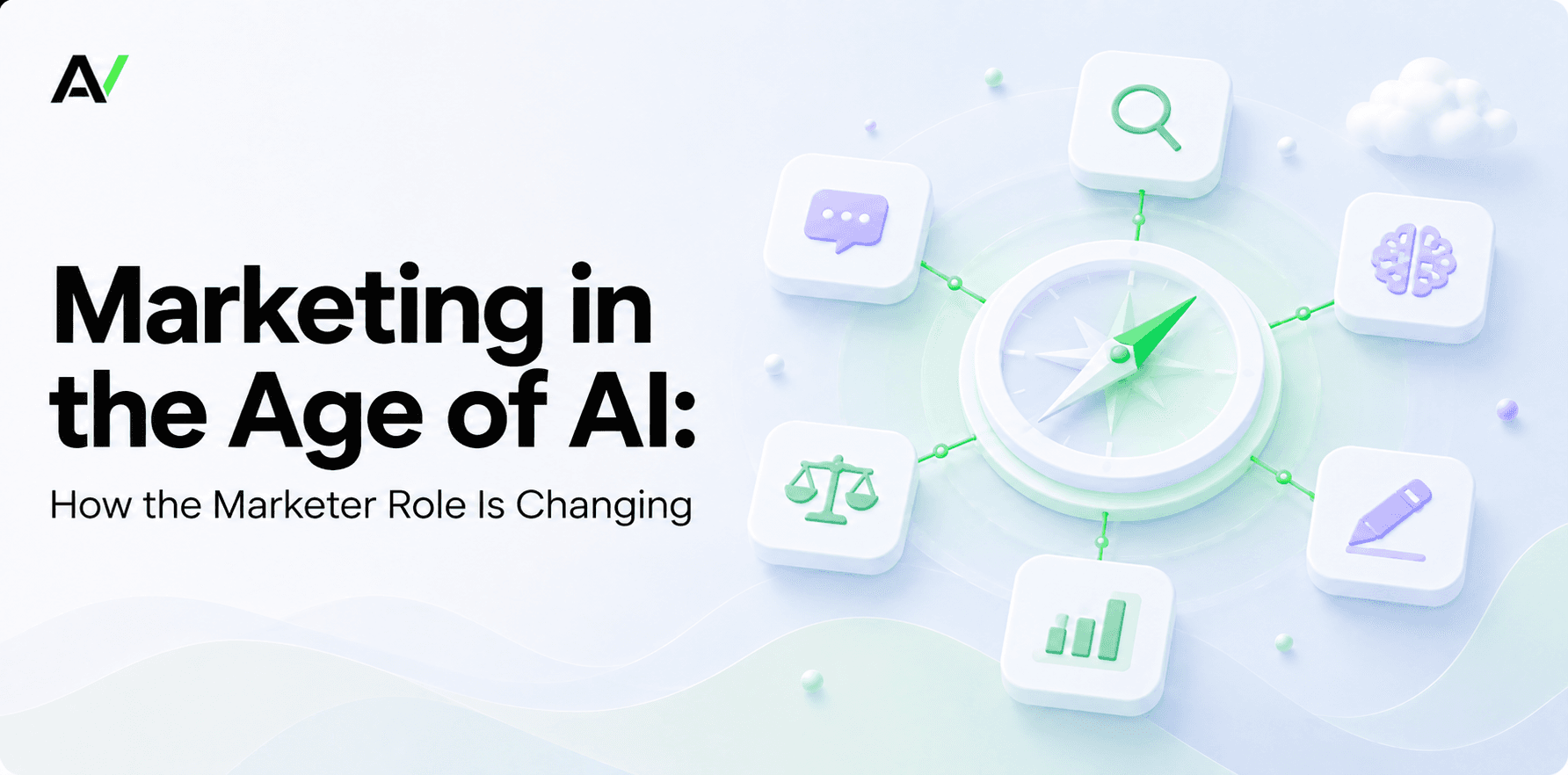
Marketing in the Age of AI: How the Marketer Role Is Changing
AI is changing marketing from asset production to evidence, judgment and connected execution. Learn the skills and systems that matter now.
August 14, 2026 · 11 min read
On this page
Article · AI Strategy
AI is changing marketing. But the most important change is not that a model can write a first draft, generate an image, summarize a customer interview, or propose a campaign idea in seconds.
The deeper change is economic and professional: the cost of producing a marketing output is falling, while the value of deciding what deserves to be produced is rising.
For years, many marketing roles were defined by throughput. Could you produce enough posts, emails, landing pages, reports, ads, presentations, and campaign variations to keep up with the calendar? AI makes that question less scarce. It can help a small team create a large volume of plausible work. But plausible is not the same as useful. A full content calendar can still miss the customer. A polished campaign can still rest on the wrong assumption. A fast report can still leave a team unclear about what to do next.
That is why the profession is being reshaped rather than simply automated. The marketer of the AI era is not only a maker of assets. They are increasingly a researcher, editor, systems designer, decision-maker, and steward of brand judgment.
The old unit of work was the asset. The new unit is the decision.
In a traditional workflow, marketing often moves in fragments. A research document sits in one folder. A positioning deck sits in another. A campaign brief is rewritten in a third place. Content is created in chat, passed into a calendar, and finally sent to a designer or freelancer with little of the original reasoning attached.
Each handoff loses context. That loss creates rework: the same questions are asked again, claims change between channels, and teams produce content before agreeing on the audience, offer, proof, or action they want the reader to take.
The better use of AI is to strengthen the chain from signal to decision to action:
raw context → evidence → interpretation → decision → campaign work → review → learning
AI makes execution cheaper. It makes judgment more valuable.
The 2026 American Marketing Association State of Marketing Careers Report offers a useful picture of the shift. It surveyed 1,412 marketing practitioners, combined with job-posting analysis and industry interviews. The report classifies areas such as email marketing, SEO, paid media, performance analytics, copywriting, lead generation, market research, and graphic design as highly exposed to AI automation. By contrast, it places marketing strategy, brand management, critical thinking, creativity, leadership, ethical decision-making, and adaptability among the most human-led activities.
This does not mean that copywriters, analysts, researchers, or designers disappear. It means their leverage changes. A strong practitioner can use AI to explore more options, identify patterns faster, create better first drafts, and reserve more time for judgment. A weak workflow can use AI to flood the market with generic output.
The distinction is not “human versus machine.” It is whether the human remains responsible for the questions that define quality:
- Is this the right audience, or simply the most obvious audience?
- Is this a real customer insight, or a fluent summary of familiar language?
- Is this claim supported, distinctive, and safe to make?
- Does this campaign reinforce the brand we are trying to build?
- What would cause us to change our mind after launch?
These are not finishing touches. They are the work. AI gives marketers more surface area to manage, so discernment becomes a core production skill.
The new marketer works like a strategist and an editor at the same time.
A useful way to understand the emerging profession is to think of a marketer as the editor of a living operating system.
An editor does not merely correct sentences. They decide what belongs, what is missing, what needs evidence, what deserves emphasis, and what should be cut. In the same way, the AI-era marketer curates inputs and sets standards for outputs.
This begins with context. AI can only make a marketing system more coherent if it has access to coherent inputs: a clear description of the product, audience research, competitive observations, brand rules, customer language, existing performance signals, legal or approval constraints, and the decisions already made. Without that foundation, “personalization” becomes a style effect rather than relevance.
The next job is interpretation. A transcript might reveal that customers repeatedly describe a problem in one phrase. A website audit might show that the category is misunderstood. A campaign report might show strong reach but weak qualified action. AI can help surface these patterns. It should not be allowed to convert them automatically into certainty.
The marketer turns evidence into a proposition: this audience is the priority; this problem is the entry point; this proof is missing; this channel should be tested; this message needs to change. Then the team can use AI to turn the approved decision into campaign work - copy, concepts, briefs, variations, checklists, content plans, or review-ready artifacts.
Search is a warning: visibility is no longer the whole outcome.
AI is also changing the environments in which marketing work is measured. Search is the clearest example.
A 2026 field experiment on Google AI Overviews used a custom Chrome extension to randomly assign users to standard Google Search with AI Overviews or a version without them. When an AI Overview appeared, the study found a 39.8% reduction in outbound organic clicks and a 34.5% increase in zero-click searches. It found no measurable improvement in perceived search quality or ease of finding information.
One study does not settle every question about search behavior. But it reinforces an operational point that marketers cannot ignore: rank position, visibility, citation, click, and qualified action are no longer interchangeable.
This changes the shape of SEO and AEO work. The shallow response is to chase every new acronym or produce pages designed only to be summarized. The stronger response is to ask what makes a brand worth selecting after an answer is already available on the results page.
That can mean creating original evidence, clearer product explanations, differentiated points of view, useful tools, authoritative comparisons, credible demonstrations, and content that helps a buyer make a decision rather than simply learn a definition. It also means measuring more carefully: answer visibility, source citations, branded search, qualified visits, conversion quality, and the learning produced by each experiment.
New tools create a need for new operating discipline.
The arrival of better tools does not automatically create better marketing. It often reveals whether a team has a real operating model.
Consider a team that asks an AI tool for a competitive analysis. If it cannot state the market question, validate sources, separate facts from assumptions, or name the decision the analysis should influence, the output will be difficult to trust. The same is true for content generation. If a team has no message map, proof library, channel rules, or approval process, it will generate a lot of work but accumulate little learning.
The World Economic Forum’s *Future of Jobs Report 2025* is based on the perspective of more than 1,000 employers representing over 14 million workers across 55 economies. Its premise is not that one technology determines the future of work, but that technological change, economic uncertainty, demographics, and the green transition are reshaping skills together. For marketers, that is an important reminder. AI fluency cannot be a separate “tool skill” added to an unchanged job description.
The stronger teams will redesign how work moves.
They will define inputs before prompting. They will distinguish source-backed findings from hypotheses. They will make a strategic decision explicit before launching execution. They will identify who can approve a claim or a campaign. They will preserve the original assumption next to the result. And they will create a feedback loop that changes future work.
This is not bureaucracy. It is how speed becomes compounding rather than chaotic.
The new professional stack: six capabilities that matter more now.
The marketer of the AI era does not need to become an engineer. But they do need a more deliberate professional stack.
- Research literacy. Marketers need to know how to locate primary sources, assess the credibility of a claim, recognize when data is incomplete, and distinguish an observed fact from an interpretation. AI can accelerate discovery; it cannot remove the need for evidence.
- Problem framing. A good prompt is not magic wording. It is a well-defined business question with context, constraints, a desired decision, and a definition of quality. Teams that frame poorly will automate confusion.
- Taste and editorial judgment. As generic content becomes easy to create, specificity becomes more valuable. The marketer needs to see when language is interchangeable, when a visual does not carry the argument, when an idea lacks proof, and when a campaign sounds like everyone else.
- Systems thinking. Marketing is not a collection of channel outputs. It is a sequence of linked decisions: audience, problem, position, message, offer, channel, execution, measurement, and learning. New tools are most useful when they reduce the cost of moving through this sequence without losing context.
- Measurement design. Teams need to define success before an asset goes live. That means choosing measures that fit the job: qualified pipeline, activation, a completed next step, evidence of message resonance, or a decision validated or invalidated. Likes, impressions, and raw traffic are signals, not automatic conclusions.
- Governance and responsible use. A marketer must know what AI should not decide alone: unverified factual claims, regulated statements, brand commitments, sensitive audience inferences, public publishing, and paid actions. Review is not a sign that the tool failed. It is part of the system that makes rapid experimentation safe.
Together, these capabilities make a marketer more valuable because they make the whole team more reliable.
How teams can begin without creating another AI theater project.
The wrong starting point is a company-wide mandate to “use AI more.” It creates activity without a learning agenda.
Start with one recurring workflow where the cost of context loss is obvious. For an agency, it might be turning a client discovery call, website, and research into an approved campaign brief. For a lean B2B team, it might be moving from an SEO or market report to a decided message, content plan, and test. For a product-marketing team, it might be turning customer interviews into a proof-backed launch narrative.
Then run a bounded experiment:
- Name the business decision the workflow must support.
- Gather the source material and identify what is unknown.
- Define what a useful output looks like and who will review it.
- Use AI to accelerate synthesis and draft connected work.
- Record what was accepted, changed, rejected, and why.
- Measure whether the team reached a usable decision faster and with better confidence - not merely whether it generated more text.
This process gives a team something much more valuable than a collection of prompts. It gives them a reusable way of working.
The future of marketing is not automated content. It is accountable momentum.
The most optimistic vision of AI in marketing is not a machine that replaces marketers. It is a profession that becomes more rigorous about what only marketers can do: understand people in context, make trade-offs, protect a brand, turn insight into a point of view, and create work that earns a response.
New tools can reduce the distance between a messy input and a useful first draft. They can help teams explore options, maintain consistency, and produce work at a speed that was previously reserved for much larger organizations. But speed alone does not create momentum.
Momentum comes from carrying context forward. It comes from knowing which evidence produced a decision, which decision produced an action, and what the action taught the team.
That is the profession marketers now have the opportunity to shape.
Where ActVox fits
ActVox is being built around this operating shift: turning raw marketing context into source-backed, reviewable work that can move from research and audit to a clear decision, campaign work, and a reviewable next action.
The goal is not another place to generate isolated marketing assets. It is a more connected handoff between what a team learns and what it decides to do next.
For agencies and lean marketing teams, that matters because the competitive advantage of AI will not be who can generate the most. It will be who can turn evidence into better decisions - and turn those decisions into work that a team can confidently approve and execute.
Next step
Put this to work on your business
For a business-specific version of this framework, run a free audit and get an actionable plan built from your real digital footprint.
Start my free auditRelated · Same topic
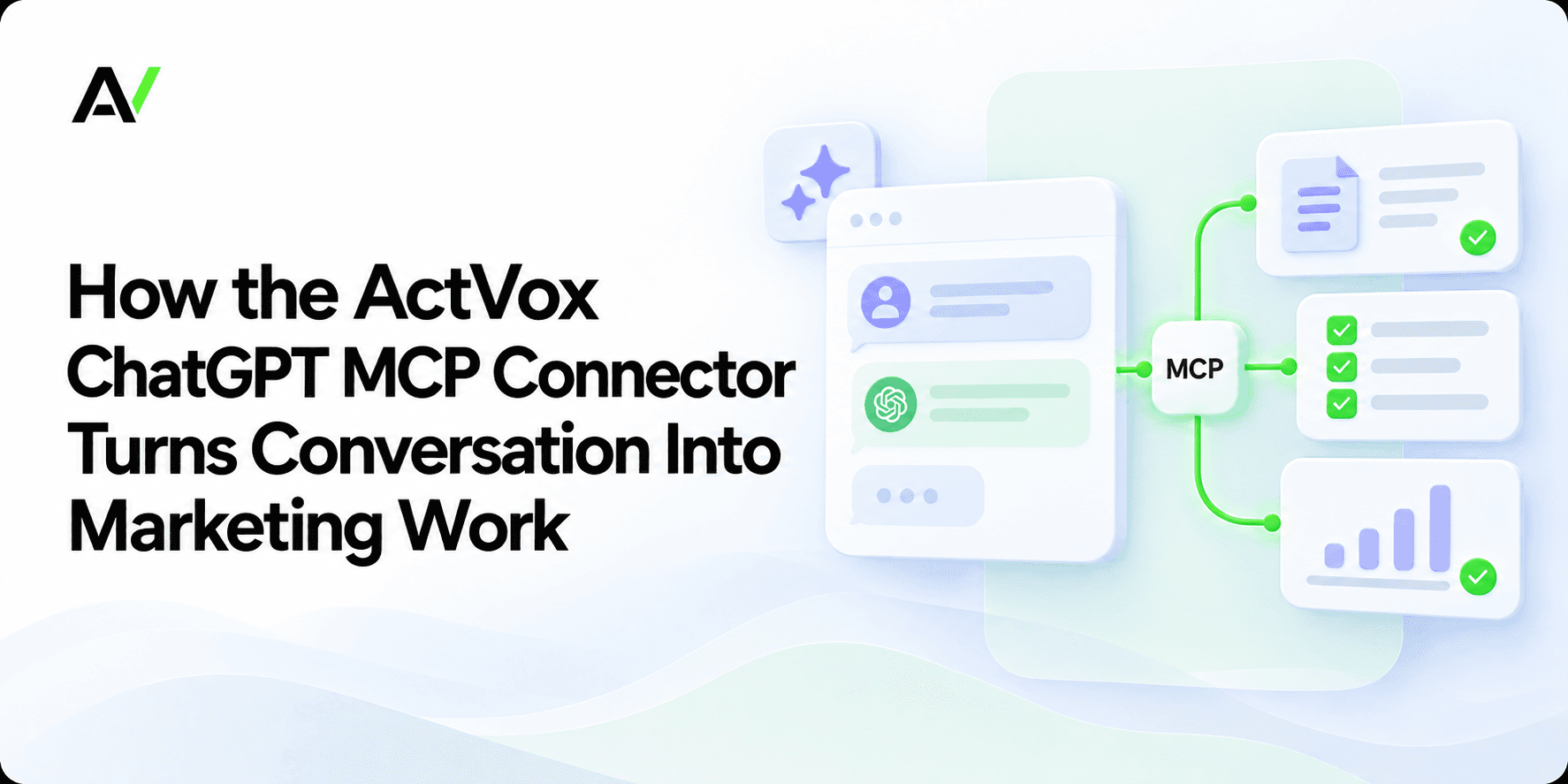
How the ActVox ChatGPT MCP Connector Turns Conversation Into Marketing Work
A connected workflow for moving from a ChatGPT question to grounded, reviewable work in ActVox.
Best AI Marketing Tools for Small Businesses
A practical guide to choosing AI tools for strategy, SEO, content, social media, CRM, and automation.
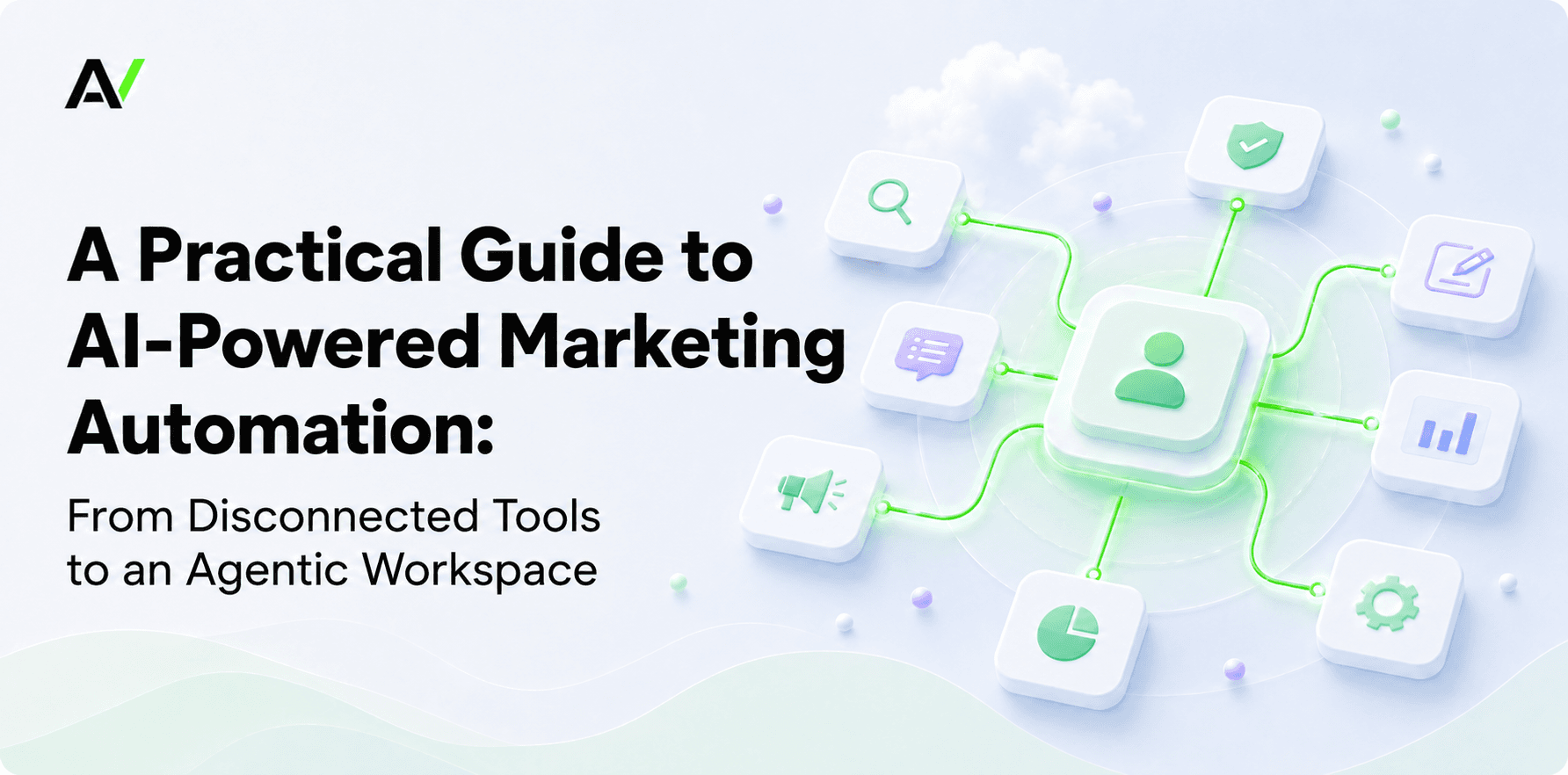
A Practical Guide to AI-Powered Marketing Automation: From Disconnected Tools to an Agentic Workspace
Peak martech has not reduced the marketing workload. It has exposed how much time small teams lose between tools. This guide explains how SMBs can use AI-powered automation to connect research, strategy, content, approvals, and measurement without removing human control.