Playbook · AI Strategy
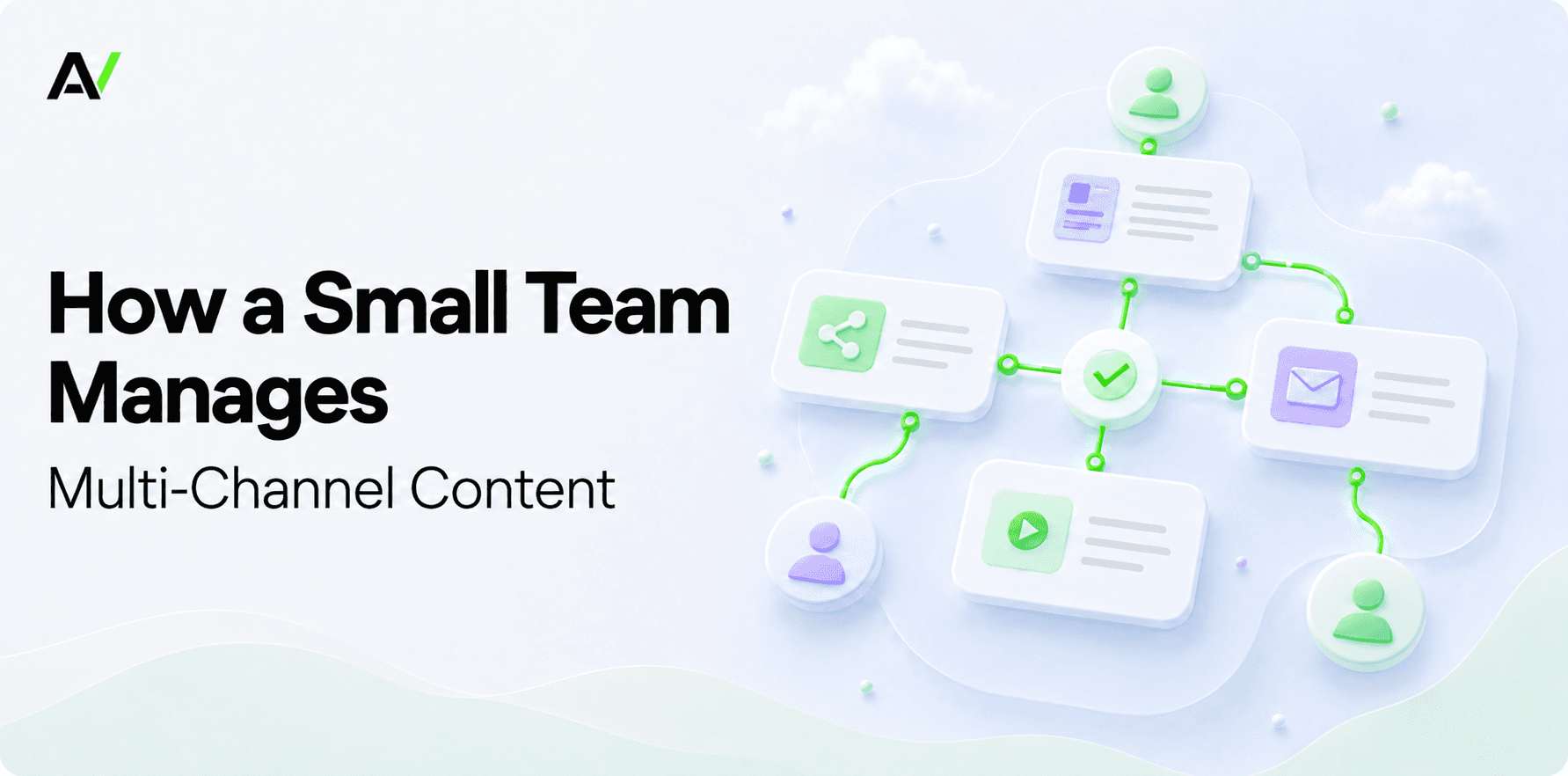
How a Small Team Manages Multi-Channel Content
Learn how a 3-person team plans, creates, repurposes, approves, and distributes content across multiple channels using a lean content operations workflow.
February 14, 2026 · 7 min read
On this page
Article · AI Strategy
A field-tested setup for planning, producing, measuring, and shipping content every week without burning out the team.
A three-person team can publish across a blog, LinkedIn, X, Instagram, and a newsletter. The difficulty is doing it weekly without posts slipping, reviews stalling, or the calendar losing its purpose.
Sustainable teams remove coordination overhead: one source of truth, ownership by decision rather than channel, and a weekly rhythm for production and review. They also measure more than traffic and rankings. Content may appear in ChatGPT or Google AI Overviews before a buyer visits the website, so modern teams must understand traditional SEO vs AI search visibility.
Start with capacity, not channel count
Ask, “How many strong source ideas can we produce each week?” The sustainable answer may be one or two. A researched article can become a LinkedIn post, X thread, carousel, newsletter section, and video script. Adapt its opening, evidence, format, depth, and CTA for each platform. Planning campaign families creates a realistic production unit.
Keep one shared strategy surface
Small teams often fragment strategy, ideas, drafts, feedback, and scheduling across different tools. Every handoff loses context and consumes time.
Keep positioning, research, briefs, drafts, states, assets, calendar, and results in one workspace. Decisions must remain visible where the work lives. ActVox connects this context through its workspace, Brand DNA, Knowledge Base, content tools, and calendar. Each asset needs an owner, audience, source, deadline, status, CTA, and measurement goal.
Split roles by decision, not by channel
“One person per platform” scales badly. If three people independently research, write, edit, schedule, and analyze, work is duplicated and nobody owns the campaign.
Use three decision-based roles:
- Strategy owner: decides what gets made and why; owns campaign themes, priorities, briefs, and final approval.
- Production owner: decides how ideas become assets; owns drafting, platform adaptation, visual production, and version control.
- Distribution and insights owner: decides when and where work ships; owns scheduling, community responses, tracking, and the weekly report.
This prevents bottlenecks.
Establish a weekly operating rhythm
A repeatable week beats a heroic one. A practical cadence is:
- Monday-planning, 30 minutes: review results, confirm the campaign, select ideas, and attach briefs.
- Tuesday-source production: collect questions, product insight, search demand, competitor examples, and evidence; draft the core narrative.
- Wednesday-adaptation: create platform-native posts, visuals, newsletter copy, and video scripts.
- Thursday-review: examine next week’s work in one pass and comment directly on each asset.
- Friday-scheduling and retrospective, 30 minutes: schedule work, move incomplete assets deliberately, update metrics, and choose one improvement.
Batch research, production, and adaptation
Context switching is a silent tax. Use separate sessions for briefs, source drafts, adaptations, and scheduling. A strong brief defines the audience question, argument, evidence, action, channels, and campaign. Build it from customer calls, sales objections, product changes, search gaps, competitor coverage, and AI-generated questions.
Repurpose deliberately: LinkedIn can carry the business argument, X the sharpest claim, Instagram a visual sequence, the newsletter added context, and the blog the evidence. Link every adaptation to its source so the team can update and compare the full content family.
Build approvals that do not stall
Use a scheduled review window and visible states: brief, drafting, ready for review, changes requested, approved, scheduled, published, or archived. If the reviewer misses the window, the strategy owner decides whether to ship, revise, or move the asset. Silence is not a veto. Label feedback as accuracy, strategy, brand, structure, or polish.
Add an AI search visibility scorecard
An AI search visibility scorecard gives the Friday review a consistent measurement layer.
Traditional SEO tracks rankings, impressions, clicks, click-through rate, and conversions from search results. AI search visibility metrics answer different questions: Does the brand appear in generated answers? Is it cited as a source? Is the description accurate? How often does it appear compared with competitors? Which prompts and topics trigger it?
A page can rank well and remain absent from an AI answer; a brand can also be mentioned without receiving a click.
Track these generative engine optimization metrics weekly:
- Brand mention rate: percentage of tested prompts in which the brand appears.
- Citation rate: percentage of answers that cite the brand’s owned content.
- Answer accuracy: percentage of mentions that correctly describe the company or offer.
- Topic coverage: priority topics for which the brand appears.
- AI search share of voice: brand appearances compared with tracked competitors.
- AI-referred outcomes: detectable visits and conversions from AI platforms.
- Google AI Overview presence: tracked queries where the brand or its pages appear.
How to measure AI search visibility
Begin with a fixed prompt set instead of random searches. Include branded, category, comparison, problem-based, local-intent, and high-intent recommendation questions. For each test, record the engine, prompt, date, market, brand mention, linked sources, competitors, answer accuracy, and landing page.
This is how to track brand mentions in AI search: repeat the same commercially relevant questions on a consistent schedule and store the answers as observations. Generated responses can vary, so run high-priority prompts more than once and treat the results as directional evidence rather than a universal ranking.
To understand how to measure citations in AI-generated answers, separate mentions from citations. A mention names the brand; a citation identifies or links to a supporting source. Count both, then calculate:
Citation rate = answers citing owned content ÷ total tested answers × 100
For teams asking how to measure AI search share of voice, compare the brand with selected competitors across the same prompt set:
AI search share of voice = brand appearances ÷ total appearances for all tracked brands × 100
Also review which topics create visibility, which sources engines prefer, and whether the brand appears in decision-stage questions.
Monitor ChatGPT and Google AI Overviews separately
To monitor ChatGPT search visibility, record brand mentions, descriptions, supporting sources, and owned-content citations. Keep results separate by engine because retrieval behavior differs.
Teams researching how to track Google AI Overview rankings should avoid forcing classic positions one through ten onto a generated response. Instead, record whether an AI Overview appears, whether the brand is included, whether its page is cited, where the citation appears, and which competitors or publishers are referenced. Preserve normal Search Console data for the underlying query and page so AI visibility can be viewed alongside traditional performance.
Create a useful report and dashboard
An AI search visibility report template can be concise. Include:
- The most important weekly change and why it matters.
- Mentions, citations, accuracy, topic coverage, share of voice, and referred outcomes.
- Prompts or topics that improved, declined, or changed sources.
- Pages to strengthen, questions to answer, facts to clarify, and proof to add.
- Three prioritized actions with owners and deadlines.
This makes weekly GEO reporting for SEO teams operational. The report should create briefs, not end with a graph. Repeated competitor citations may justify a better comparison page; inaccurate brand descriptions call for clearer company facts, structured data, and trusted-source profiles.
An AI SEO dashboard for marketing teams should display trends in mention rate, citation rate, share of voice, topic coverage, accuracy, referred outcomes, and cited pages. Break results down by engine, topic, market, and buyer stage.
Weekly AI search performance checklist
Use this checklist during Friday’s retrospective:
- Run the fixed priority prompt set across selected engines.
- Capture mentions, AI search citations, competitors, sources, and accuracy.
- Check tracked queries for changed Google AI Overviews.
- Review AI-referred traffic and conversions.
- Calculate mention rate, citation rate, and share of voice.
- Identify one gain and one material visibility gap.
- Turn the gap into a page update, new brief, or distribution task.
- Assign an owner and due date in the shared workspace.
- Save the weekly snapshot for comparison.
This is the foundation of weekly AI search reporting: measurement becomes part of content operations, and every insight creates a specific action.
What to stop doing
Stop publishing on channels that show no signal after a fair test. Stop creating one-off posts with no campaign, reviewing in chat, or treating every platform as a separate strategy. Stop measuring only clicks, because AI discovery can create consideration before a session. Above all, stop planning more than the team has ever shipped. A calendar the team beats builds momentum; a calendar that beats the team creates burnout.
Three people running this loop can out-publish a larger team operating on heroics because they spend less time reconstructing context, chasing approvals, switching tasks, and guessing. When production, SEO, and AI visibility share one weekly system, every asset creates evidence for the next.
Put this to work on your business
For a business-specific version of this framework, run a free ActVox audit and get an actionable plan built from your real digital footprint-covering SEO, AEO, competitors, content gaps, and execution priorities.
Next step
Put this to work on your business
For a business-specific version of this framework, run a free audit and get an actionable plan built from your real digital footprint.
Start my free auditRelated · Same topic
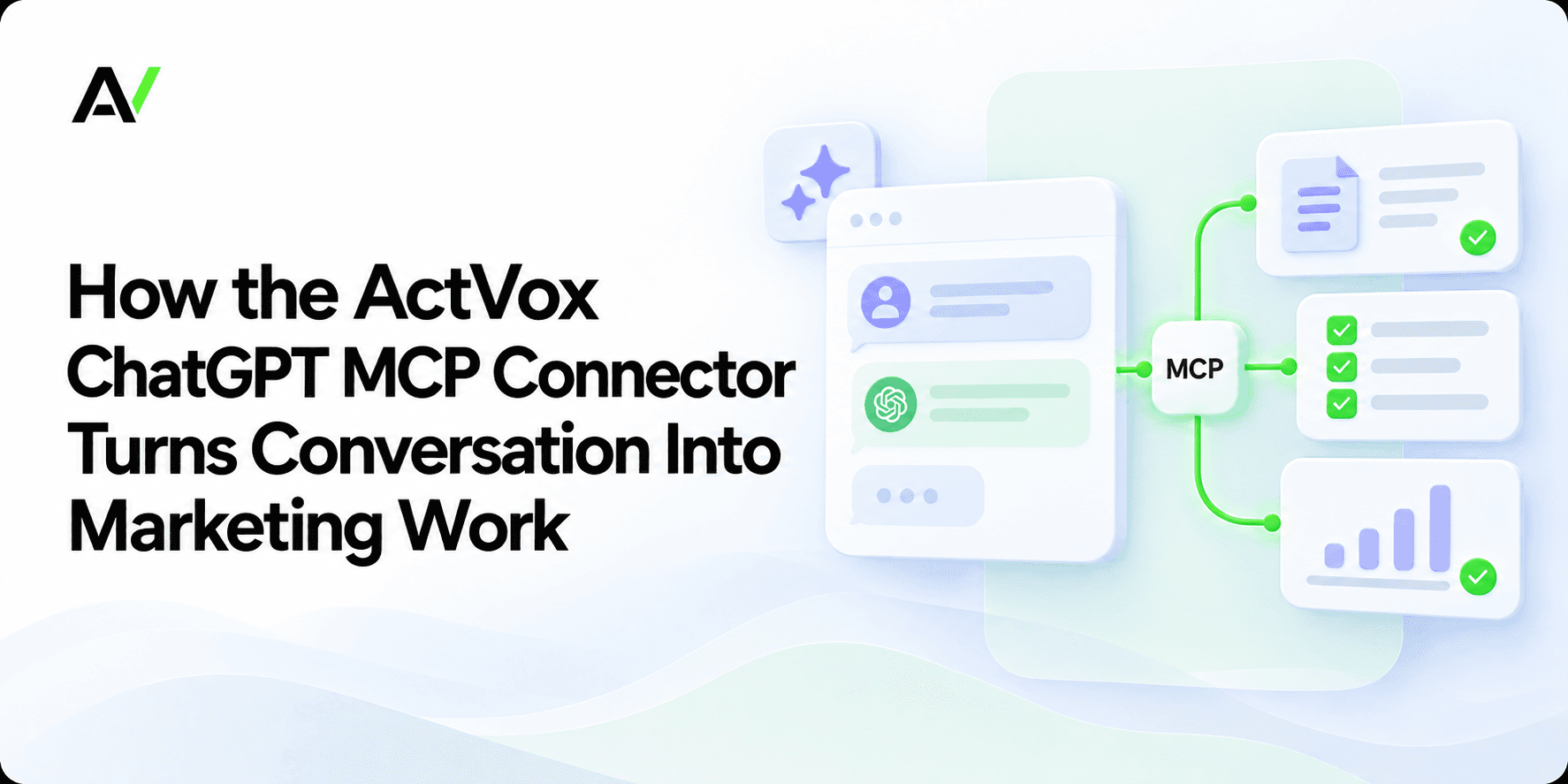
How the ActVox ChatGPT MCP Connector Turns Conversation Into Marketing Work
A connected workflow for moving from a ChatGPT question to grounded, reviewable work in ActVox.
Best AI Marketing Tools for Small Businesses
A practical guide to choosing AI tools for strategy, SEO, content, social media, CRM, and automation.
Marketing in the Age of AI: How the Marketer Role Is Changing
AI is changing marketing from asset production to evidence, judgment and connected execution. Learn the skills and systems that matter now.