
How the ActVox ChatGPT MCP Connector Turns Conversation Into Marketing Work
September 17, 2026 · 6 min read
A connected workflow for moving from a ChatGPT question to grounded, reviewable work in ActVox.
On this page
Article · AI Strategy
A connected workflow for moving from a ChatGPT question to grounded, reviewable work in ActVox.
Most marketing work does not fail because a team cannot generate a first draft. It fails because the work begins in one place and must be rebuilt in several others. A question starts in ChatGPT. The supporting context lives in a website, an audit, a brief, a task board, a report, or someone’s head. By the time the team is ready to act, the evidence, decision, and next step have drifted apart.
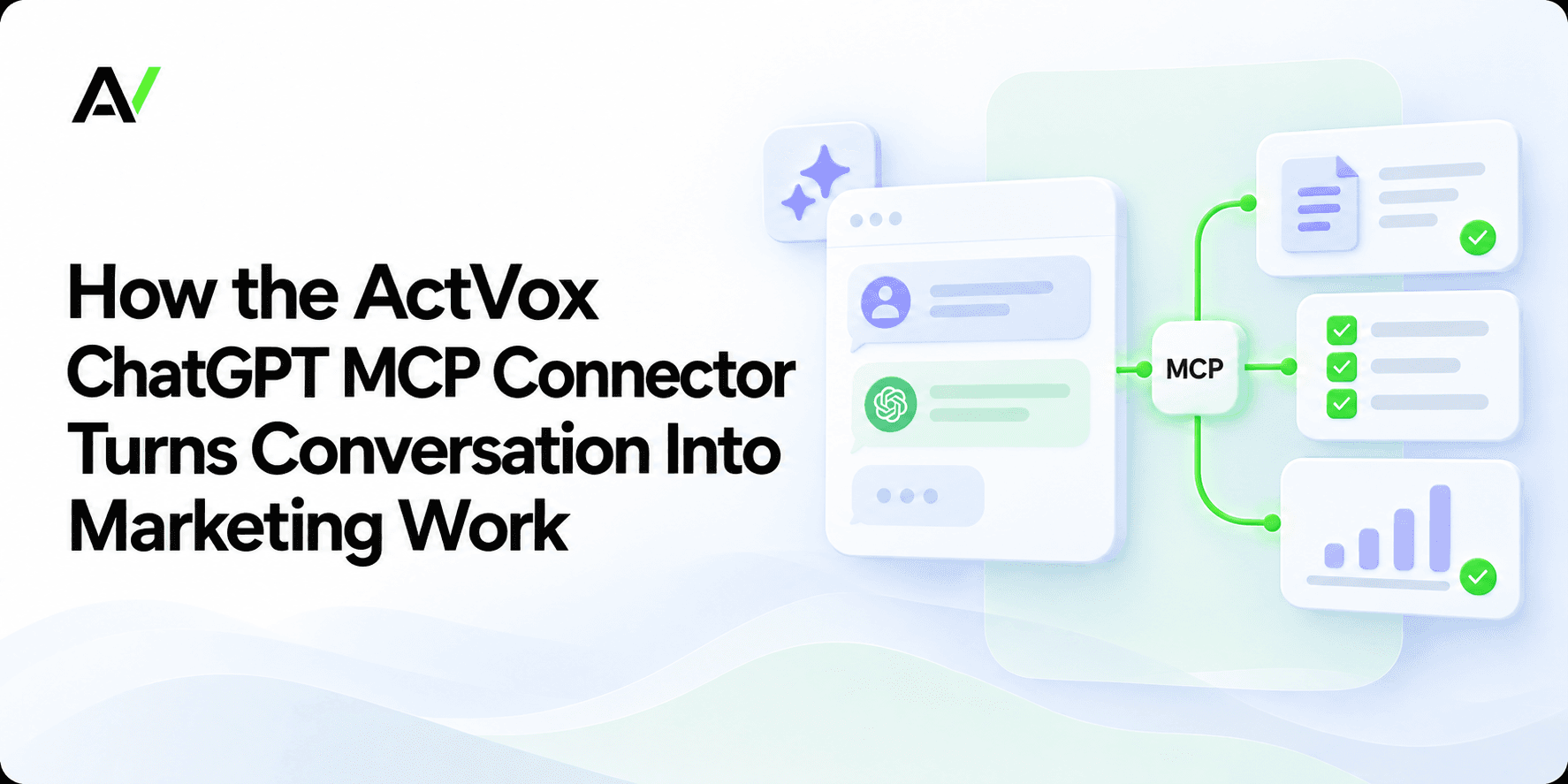
The ActVox ChatGPT MCP connector is designed to close that gap. It connects an eligible ChatGPT workspace to an ActVox workspace through Model Context Protocol (MCP), so ChatGPT can use approved ActVox tools within a conversation. The point is not to turn ActVox into another chat window. The point is to keep the path from marketing context to a decision and then to reviewable work intact.
What MCP changes
Model Context Protocol is a standard way for an AI application to call tools and retrieve information from another system. In ChatGPT, a custom MCP app can be configured by an eligible workspace administrator, tested privately, and then made available under the workspace’s controls. Depending on the app and permissions, ChatGPT can retrieve information and take supported actions.
That changes the working model. Instead of copying an audit into a chat, asking for recommendations, then manually recreating the useful parts in a plan or task list, a team can bring approved ActVox workspace context into the same conversation where it is being discussed. The conversation becomes a decision surface, not a dead end.
The practical workflow
A useful marketing workflow still starts with evidence, not a prompt. In ActVox, that may include business context, a website, a report, competitors, source material, existing pages, and prior decisions. ChatGPT can then help a team interrogate that context, for example: What did the audit identify as the highest-priority visibility gap? Which audience assumptions are supported by the current evidence? What needs to be decided before a campaign brief can be created?
- Start with a real marketing question, not an empty prompt.
- Retrieve the relevant ActVox context and identify what is known, inferred, and unresolved.
- Turn the discussion into an explicit decision: audience, message, offer, priority, experiment, or next action.
- Create or update the reviewable ActVox work that follows from that decision, subject to the permissions and approvals in place.
- Review the result in ActVox, where the related context and downstream work remain available to the team.
The value is not ‘ChatGPT writes marketing faster.’ It is a stronger handoff: context → evidence → decision → reviewable marketing work.
A concrete example
Imagine a lean B2B marketing team preparing a launch. They have a fresh ActVox audit, several competitor observations, a draft positioning page, and a list of content ideas. In a normal workflow, someone would collect fragments from each source, paste them into ChatGPT, and hope the resulting brief is consistent. Later, someone else would recreate the approved direction in tasks and pages.
With the connector, the team can ask ChatGPT to work from the appropriate ActVox context: identify the two most defensible audience tensions, surface the evidence behind each, and propose the decision that needs human review. Once the team chooses a direction, the next piece of work can be created or updated in the ActVox workspace through the approved connector actions. The output is not presented as a finished truth. It remains a draft with a visible basis for review.
Why this is different from prompting with a file
Uploading a document to a chat can be useful. But it is usually a one-time context transfer. The team still has to remember where the information came from, decide what to trust, and rebuild the outcome in the systems that carry the work forward.
ActVox is built around a persistent marketing workspace. Its purpose is to connect the inputs, research, decisions, pages, tasks, briefs, sources, and calendar work that make up an operating marketing system. The connector brings that connected system into ChatGPT when a conversation is the fastest place to inspect, challenge, or advance the work.
Control remains part of the product
A connector should not turn an assistant into an unchecked operator. The ActVox connection uses workspace-scoped authorization, and the available tools are determined by the connection and workspace permissions. In ChatGPT, administrators can review and control which app actions are available. ChatGPT may request confirmation for actions that can have a meaningful effect outside the conversation, while especially risky actions may be blocked.
That is the right operating model for marketing work. ChatGPT can help investigate and prepare. ActVox can retain the workspace context and work objects. People remain responsible for the strategic decision and for approving consequential actions.
Who it is for
The connector is most useful for teams already dealing with the cost of marketing handoffs: agencies moving from client context to an approved campaign pack, fractional leaders managing several client workspaces, and lean in-house teams that need research, strategy, and execution to share the same operating context.
It is not a reason to replace strategy with chat. It is a way to make the strategic conversation more grounded and make its next step easier to review and execute.
How access works
The ActVox connector is configured as a custom ChatGPT MCP app for eligible ChatGPT workspaces. Availability depends on the ChatGPT plan, workspace settings, role, and the connector permissions selected by an administrator. As of September 2026, OpenAI describes full MCP support, including write and modify actions, as a beta capability for ChatGPT Business, Enterprise, and Edu; access and interface details can change. The connector is not a claim of unrestricted automation or automatic publishing.
For teams evaluating the connection, the practical first test is simple: choose one existing ActVox workspace, connect it with the minimum required scope, ask one read-first question, and confirm that the answer points back to a decision your team can actually act on. Only then should you enable any supported write actions for a controlled workflow.
The shift: from answers to operating context
ChatGPT is powerful at helping a team think through a problem. ActVox is being built to keep the marketing context and resulting work connected as that problem moves toward execution. The MCP connector combines those strengths: conversational reasoning when a team needs it, and a persistent marketing workspace when the decision needs to survive the conversation.
Raw context → grounded analysis → clear decision → reviewable work → approved next action.
Next step
Put this to work on your business
For a business-specific version of this framework, run a free audit and get an actionable plan built from your real digital footprint.
Start my free auditRelated · Same topic
Best AI Marketing Tools for Small Businesses
A practical guide to choosing AI tools for strategy, SEO, content, social media, CRM, and automation.
Marketing in the Age of AI: How the Marketer Role Is Changing
AI is changing marketing from asset production to evidence, judgment and connected execution. Learn the skills and systems that matter now.
A Practical Guide to AI-Powered Marketing Automation: From Disconnected Tools to an Agentic Workspace
Peak martech has not reduced the marketing workload. It has exposed how much time small teams lose between tools. This guide explains how SMBs can use AI-powered automation to connect research, strategy, content, approvals, and measurement without removing human control.