Playbook · AI Strategy
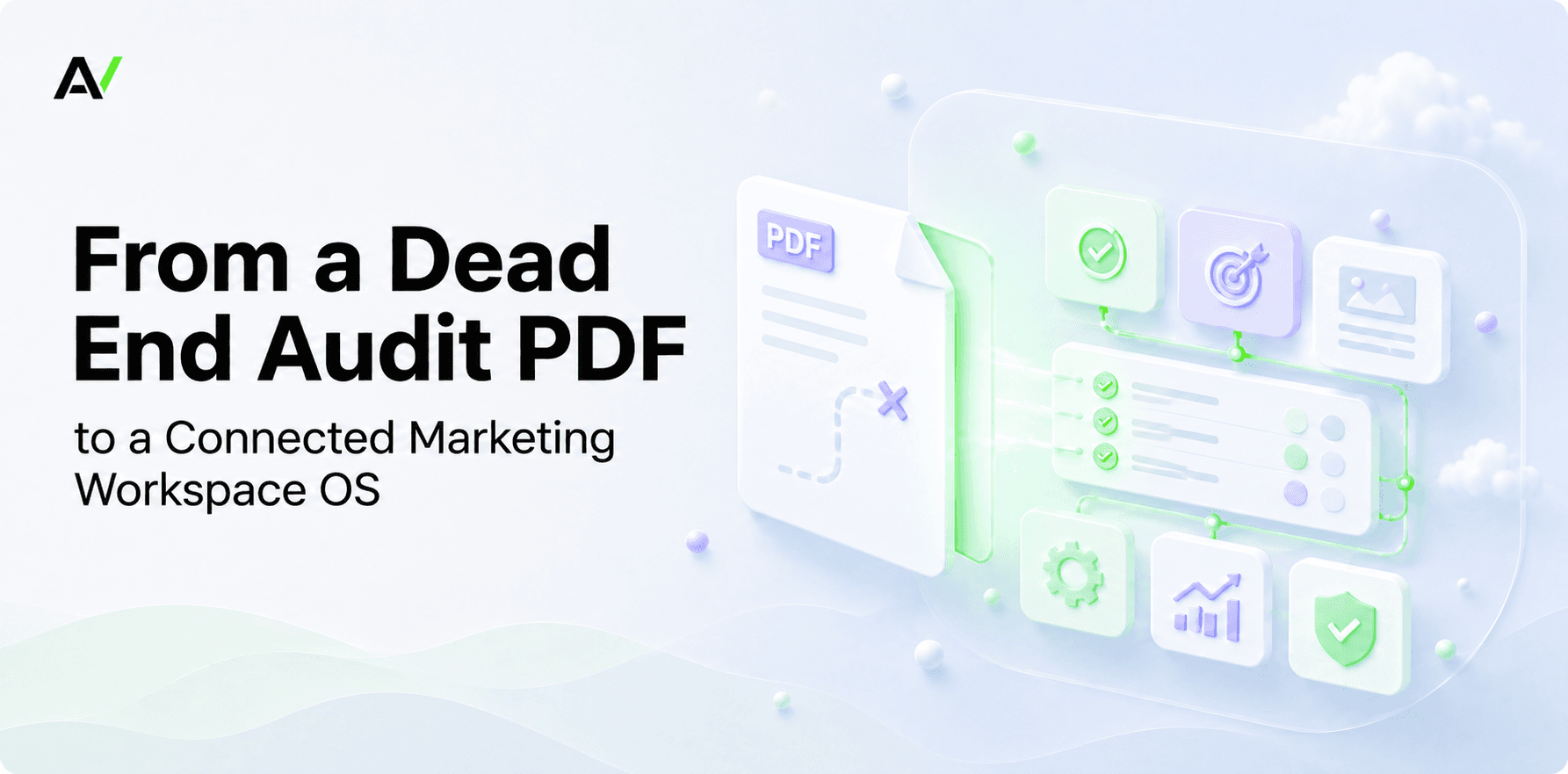
From a Dead End Audit PDF to a Connected Marketing Workspace OS
Why most marketing audits die in a folder - and how to turn SEO, AEO, competitor, social, and local findings into tasks, briefs, calendars, and approvals.
July 31, 2026 · 8 min read
On this page
Article · AI Strategy
Most marketing audits end in the same place: a PDF. It may be a strong PDF, filled with SEO issues, competitor insights, content gaps, social recommendations, and opportunities to improve visibility in search and AI-generated answers. The report is presented. The team agrees with the findings. A few recommendations are copied into a spreadsheet or project-management tool. Then the document slowly disappears into a folder.
This is not usually a research problem. The audit may be accurate and strategically useful. The real problem is that the insight has no operating system around it. A traditional audit explains what is wrong. It rarely defines what should happen first, who owns the work, what evidence supports it, or how it reaches publication.
For an in-house marketer, that gap is expensive. You may manage the website, search, social media, campaigns, freelancers, experts, and reporting. You do not need another document to organize. You need a system that turns findings into action.
ActVox connects visibility research with a shared marketing workspace where audit findings can become tasks, briefs, drafts, campaigns, approvals, and publishing decisions. The audit is the starting point. The real value comes from the work it makes possible.
A report should create momentum, not homework
A good marketing audit can answer important questions:
- Which technical SEO issues are limiting visibility?
- Is the website clear enough for AI answer engines to understand?
- What are competitors publishing that the business is missing?
- Which high-intent customer questions remain unanswered?
- Does the brand have enough proof and authority?
- How visible is the business across social and local platforms?
These answers matter, but they are not yet an execution plan. Consider a common recommendation: “Publish more expert content around customer questions.” Before publication, someone must decide which questions matter, what evidence supports the answers, who drafts and reviews the content, where it appears, and who approves it. Without those decisions, the recommendation is simply another task for the marketer to solve later.
Audits often feel useful during the presentation and overwhelming afterward because they identify opportunities without creating a production system. A report describes the opportunity. A marketing workspace preserves the reasoning, assigns the work, tracks the status, and connects the final asset back to the strategy.
The missing link: finding to task to published work
Research, strategy, production, distribution, and approval are often managed as separate projects. The audit sits in one document. Tasks live elsewhere. Research fills browser tabs. Briefs, drafts, feedback, and the calendar are scattered across folders, email, chat, and spreadsheets. Every handoff creates a risk of losing context.
ActVox creates a more connected flow. A business URL and company context can feed analysis across SEO, answer-engine optimization, competitor positioning, local visibility, social channels, content gaps, and source research. The goal is not a larger report. It is a usable foundation for ongoing work.
A finding should become a prioritized task connected to evidence. That task should generate a structured brief, guiding a draft through review, adaptation, approval, scheduling, and campaign delivery. That is what a marketing workspace OS looks like: research and execution operating inside the same context.
Build one source of truth for marketing work
Marketing operations become fragmented quickly, especially in small teams. Strategy lives in a presentation. Research is in notes and browser tabs. Content ideas sit in spreadsheets, drafts in separate documents, and feedback across Slack, email, and comments. No one deliberately designs this chaos. It develops because every tool solves one narrow problem.
The result is a coordination burden. Marketers waste time finding the latest version, rebuilding context, and chasing reviewers. A connected workspace gives the team one place to hold:
- Business positioning, audiences, offers, and priorities
- SEO, AEO, competitor, local, and social findings
- Prioritized opportunities and dependencies
- Sources, citations, proof points, and internal expertise
- Campaign themes, briefs, drafts, comments, and decisions
- Owners, deadlines, approvals, schedules, and next actions
For a lean team, this is operational leverage. The system must reduce repeated handoffs without removing human judgment. A workspace OS does not replace strategic thinking. It makes that thinking easier to apply consistently.
Turn recommendations into a prioritized work queue
Most audits produce more recommendations than a team can execute. A list of forty issues is not a roadmap. The marketer still must decide what happens now, what can wait, and what depends on another task. A connected workspace can convert findings into a work queue based on value, relevance, urgency, effort, and dependency.
- Service page misses key buyer questions → create an FAQ or supporting article brief
- Competitors rank for comparison queries → research and assign a differentiated comparison page
- Brand has weak evidence for AI answers → collect sources, expert input, customer proof, and structured facts
- Social publishing is inconsistent → build a recurring calendar around campaign themes
- Landing pages contain technical issues → assign a web task with an owner and acceptance criteria
This changes the marketer’s weekly question. Instead of asking, “What should we post this month?” the team can ask, “Which high-value visibility opportunity are we executing next, and what does it need to move forward?” That question connects production to a real business or visibility gap.
Build briefs from evidence, not blank pages
A weak content brief begins with: “Write an article about X.” That instruction may produce readable content, but rarely something differentiated or commercially useful. A strong brief explains why the asset exists, connecting the finding to the audience, business goal, evidence, point of view, distribution, and review. For example:
- Business objective: support a priority service page and increase qualified discovery.
- Audience: operations leaders comparing marketing options.
- Core question: what should a company prepare before starting a marketing audit?
- SEO and AEO opportunity: answer a high-intent question in a direct, extractable format.
- Evidence: customer questions, competitor gaps, authoritative sources, internal expertise, and examples.
- Point of view: a useful audit requires business context, reliable data, clear goals, and a path to execution.
- Format and distribution: practical guide adapted into a LinkedIn post, carousel, newsletter section, and sales asset.
- Approval: marketing reviews positioning; a subject-matter expert checks claims; the final owner approves publication.
With this structure, the reasoning travels with the work, reducing generic content and unnecessary revisions.
Keep sources connected to the draft
AI-assisted content production makes speed easier. It does not make unsupported claims acceptable. As AI-generated content grows, source discipline matters more. Customers, search engines, and AI systems benefit from specific, verifiable information.
A marketing team should be able to answer: Where did this claim come from? Is the source current? Does it support the statement? Has an expert reviewed the interpretation? Does the business have original proof?
ActVox includes source research within its analysis flow. When sources stay connected to the brief and draft, they become operational assets rather than links buried in an appendix. Teams can build around documented evidence, customer language, expertise, examples, and original proof. Reviewers can trace claims before final approval. The result is not only safer content. It is stronger content because the business has something specific to say.
Design content for search and AI answers
Traditional SEO still matters, but visibility is no longer limited to blue links. Customers discover businesses through Google, AI assistants, social platforms, video, communities, and local results. SEO asks whether a page can rank. Answer-engine optimization asks whether an AI system can understand the business, extract a useful answer, trust the evidence, and potentially recommend or cite the brand.
An audit may identify missing FAQs, unclear services, weak entity signals, insufficient proof, or thin comparison pages. Those findings can become tasks. A brief can specify the direct answer, structured facts, buyer questions, sources, proof, internal links, page format, and future updates. This creates content designed to be useful across multiple discovery systems, not only optimized for keywords.
Plan campaigns, not isolated posts
A strong idea should rarely become only one asset. One insight can support a blog, LinkedIn post, carousel, email, sales asset, FAQ, short video, or local post. Repurposing becomes inefficient when formats are created independently. A shared campaign view keeps the idea, audience, evidence, message, and call to action connected. A useful marketing calendar should show:
- Which campaign the asset supports
- Which audience and channel it serves
- Whether it is original, adapted, or repurposed
- Which owner has the next action
- What approval state it is in
- Which source asset it came from
- What can be refreshed or reused later
ActVox provides workspace and calendar surfaces for this process. Content can remain connected to the campaign even when channels require different formats or review rules. The goal is strategic consistency, with each asset adapted to its platform.
Make approvals a workflow, not a scavenger hunt
Approval is one of the biggest hidden costs in lean marketing teams. A draft may be nearly finished, but nobody knows who reviews it. Feedback arrives privately, on outdated versions, or after scheduling. The marketer becomes responsible for chasing every decision. A connected workspace makes approval visible through clear states:
- Drafting
- Ready for review
- Changes requested
- Ready for approval
- Approved
- Scheduled
- Published
- Needs updating
The system should also preserve the brief, sources, comments, owner, deadline, approval history, and calendar relationship. This is not bureaucracy. It makes decisions easier to find, responsibilities easier to understand, and delays easier to diagnose.
Operate like a larger team without becoming one
A marketing workspace OS is especially useful for organizations that are too small for specialized departments but too busy to manage everything from memory. One marketer can coordinate founders, freelancers, designers, sales, developers, and experts without rebuilding context in every meeting. The operating model is straightforward:
- Start with the website, business context, audience, and goals.
- Analyze SEO, AEO, competitors, social, local, and content visibility.
- Identify the highest-value gaps and opportunities.
- Convert findings into prioritized tasks with owners and dependencies.
- Build evidence-backed briefs linked to the original research.
- Create and adapt content for the channels that matter.
- Route work through a visible review and approval process.
- Schedule approved assets and track what was published.
- Use performance, feedback, and new research to guide the next cycle.
This creates a continuous loop rather than a one-time audit. Research informs execution. Execution produces results. Results create new learning. The workspace preserves that learning for the next decision.
Over time, this creates institutional memory for marketing. The team can see which recommendations were accepted, which messages performed, which claims required revision, and which assets should be refreshed. New employees or freelancers do not have to reconstruct the strategy from old meetings. They can follow the evidence, decisions, owners, and outcomes already stored in the workspace. This continuity becomes especially valuable as campaigns multiply, priorities change, and the business expands into new channels, audiences, services, or markets without losing the original strategic context.
The audit is not the deliverable
The real deliverable is not a PDF. The deliverable is better marketing work that the team can understand, prioritize, complete, review, and improve. A PDF can diagnose a weak page, but it cannot assign the rewrite, create the brief, connect sources, schedule the campaign, or record approval.
ActVox connects these steps in one shared environment. It helps marketers move from “we know what we should do” to “this is the next action, this is who owns it, this is the evidence, and this is when it will be published.” That is the difference between an audit and a marketing workspace OS.
The audit creates clarity. The workspace creates momentum. Because the value of marketing research is not the report itself. It is the work the report makes possible.
Next step
Put this to work on your business
For a business-specific version of this framework, run a free audit and get an actionable plan built from your real digital footprint.
Start my free auditRelated · Same topic
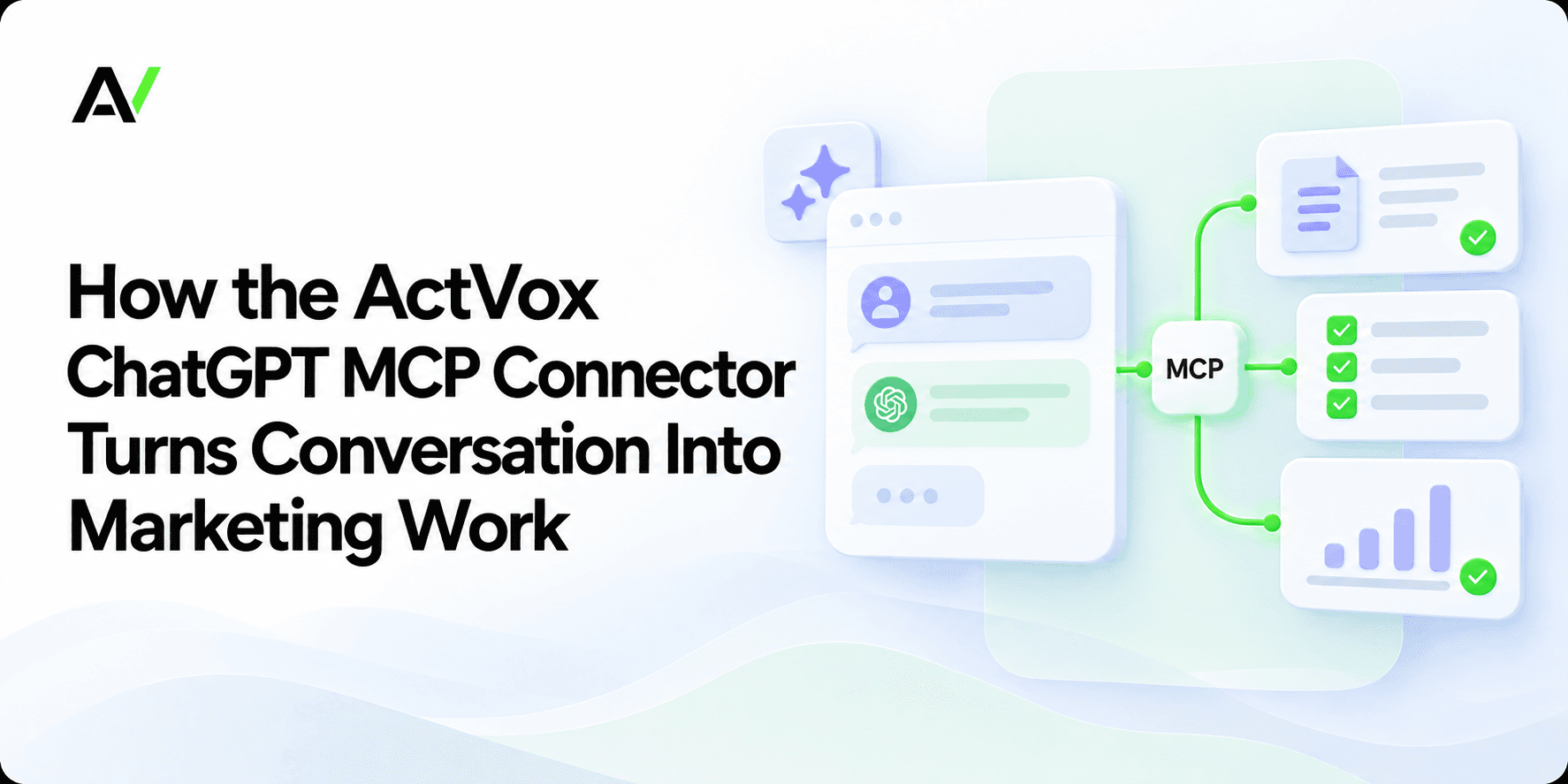
How the ActVox ChatGPT MCP Connector Turns Conversation Into Marketing Work
A connected workflow for moving from a ChatGPT question to grounded, reviewable work in ActVox.
Best AI Marketing Tools for Small Businesses
A practical guide to choosing AI tools for strategy, SEO, content, social media, CRM, and automation.
Marketing in the Age of AI: How the Marketer Role Is Changing
AI is changing marketing from asset production to evidence, judgment and connected execution. Learn the skills and systems that matter now.