Guide · SEO/GEO
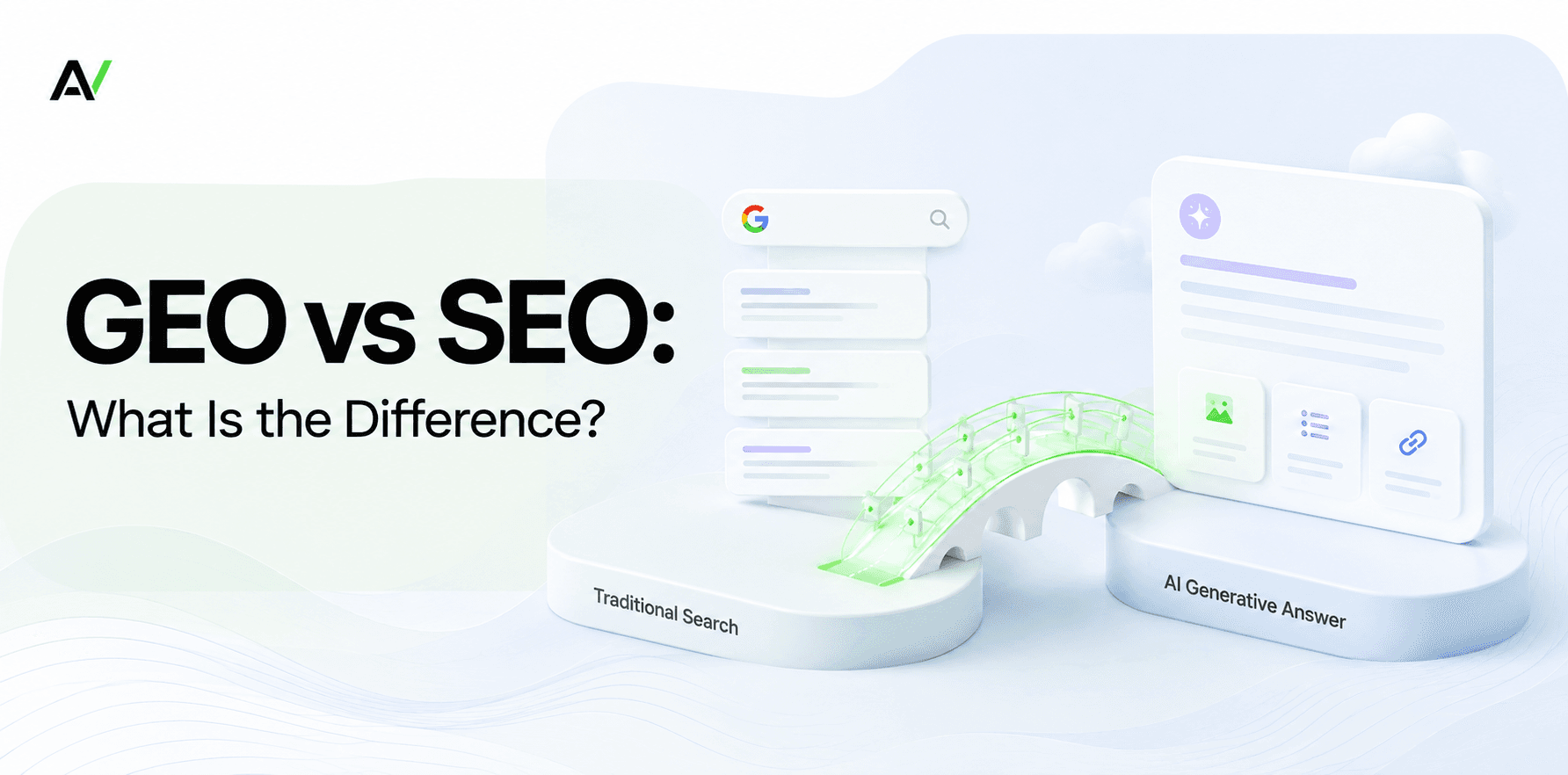
GEO vs SEO: What Is the Difference?
A practical guide to SEO, GEO, AI-search citations, and what founders should prioritize first.
February 6, 2026 · 10 min read
On this page
Article · SEO/GEO
SEO improves discovery and ranking in traditional results. GEO (Generative Engine Optimization) focuses on whether AI answers can accurately retrieve, cite, mention, or recommend your brand. Both rely on technical accessibility, clear positioning, useful content, and credible proof. GEO does not replace SEO; it expands the outcome from rankings and clicks to accurate representation, citations, recommendations, referrals, and conversions.
A buyer may search Google, ask ChatGPT to compare two tools, or use an AI assistant to find a local provider. GEO is a useful lens for the new question: Does an answer system have clear, current, trustworthy information to use about your business?
Google says AEO and GEO are common labels, but that optimizing for generative search is still optimizing for Search: its AI features use core Search ranking and quality systems. Google’s generative-AI optimization guide makes this clear.
What is SEO?
SEO makes a website easier for search engines to discover, understand, and show for relevant searches. Its goals are qualified visibility, visits, and conversion.
The work includes crawlability, indexability, internal links, site structure, page experience, search-intent relevance, and trust. A small HR software company might publish a “Payroll for Remote Teams” page with features, pricing, FAQs, and implementation details so it can appear when a buyer searches that problem.
What is GEO?
GEO is the work of making a brand, product, expertise, and supporting pages clear enough to appear well in AI-generated search and answer experiences.
Its question is: If someone asks an AI assistant about this category, does the answer understand our offer, audience, fit, and proof? Outcomes include citations, accurate descriptions, comparison mentions, and relevant recommendations. They vary by prompt, market, model, and available sources.
The HR software company can support GEO with a fair product comparison, remote-payroll checklist, implementation guide, and original compliance insights—not just a vague homepage.
GEO vs SEO at a glance
- Primary surface — SEO: Traditional search results. GEO: AI-generated answers and search chats.
- Main objective — SEO: Rank relevant pages and earn qualified visits. GEO: Be accurately understood, cited, mentioned, or recommended.
- Unit of work — SEO: A page matched to search intent. GEO: An answer, entity, evidence set, and category position.
- Core signals — SEO: Technical health, relevance, useful content, authority. GEO: Clear facts, direct answers, original proof, topical depth, trusted sources.
- Key metrics — SEO: Impressions, rankings, CTR, organic traffic, conversions. GEO: Citations, accurate mentions, recommendation presence, referrals, conversions.
- Relationship — SEO is the foundation. GEO is an AI-search application of the same foundation.
GEO is not “SEO with AI keywords.” It shifts the aim from winning a position to becoming a source that can be accurately represented in an answer.
Where GEO and SEO overlap
A vague homepage, blocked pages, thin service content, outdated facts, or no proof creates a visibility problem before it creates a GEO problem. Both disciplines need:
- A plain-English definition of the offer, audience, and differentiator.
- Crawlable pages that match real buyer questions.
- Useful, original answers with evidence and a next step.
- Accurate product, company, local, and author facts.
- Case studies, reviews, expert input, and credible third-party coverage.
Google requires a supporting page in AI Overviews or AI Mode to be indexed and snippet-eligible in regular Search; it says there are no extra technical requirements. SEO makes information discoverable; GEO makes it easier for an answer system to use.
The biggest difference: rankings versus representation
A high ranking does not guarantee an AI answer will mention you. An answer may prefer clearer comparison information, fresher details, stronger proof, or a closer use-case fit. A focused specialist page might also be cited without being the first conventional result.
ActVox separates three outcomes: cited (your page was a source), mentioned (your brand was named), and chosen (your brand was presented as a fit or the buyer acted). Citation is not the same as recommendation or conversion. Microsoft warns that citation counts do not show ranking, authority, placement, or role in an individual answer.
What GEO changes in your content workflow
Before publishing, ask: What buyer decision does this page resolve? Is the answer clear near the top? What proof makes it credible? Are the category, audience, offer, and differentiator easy to repeat? Does a comparison page explain fit and trade-offs fairly?
This does not require artificial “chunks,” dozens of query-variation pages, llms.txt, or special AI markup. Google says none is required for its generative features; it recommends unique, helpful, people-first content.
For a lean team, choose one revenue-relevant buyer question each week, build one real page that answers it, add proof, and link it to the offer. A local accountant needs clear services, local facts, credentials, reviews, prices, and buyer answers—not 30 generic tax posts.
Common GEO misconceptions
“GEO replaces SEO.” No. SEO remains the foundation.
“Schema, llms.txt, or a single prompt guarantees a citation.” No. There is no special GEO schema, and outputs vary. Use consistent prompt tests plus referral and conversion data.
“More AI-written posts solve it.” No. Generic pages rarely add evidence. Google cautions against scaled content built to manipulate results; prioritize accuracy, relevance, and user value.
How to measure GEO and SEO together
Measure SEO with indexation, non-branded impressions, positions, click-through rate, qualified organic traffic, and conversions. Measure GEO with a repeatable list of buyer prompts: record whether your brand is cited, mentioned, recommended, accurately described, or absent. Then track referral traffic and conversions from AI surfaces.
Compare both by page. If a page earns rankings but is never cited or named in relevant AI answers, examine its clarity, proof, comparison readiness, and freshness. Bing’s AI Performance reporting can show citation counts, cited pages, and grounding queries, but treat those as evidence of reference activity—not a ranking score.
Build pages that serve both systems
The strongest page does not have one version for Google and another for AI. It starts with a precise title and direct answer, then gives the reader the evidence needed to make a decision: definitions, steps, examples, prices or selection criteria where relevant, limitations, source-backed claims, and a clear action.
For instance, an ActVox guide on AI-search visibility can rank for an educational question, be cited for its framework, and introduce the platform as the practical way to audit a business URL. One well-structured, proof-rich page can therefore serve search discovery, AI answers, and conversion without becoming a content farm.
Which should you prioritize first?
Start with SEO if the site is technically weak, unclear, or missing essential pages. Add GEO thinking early when buyers ask AI tools for recommendations or comparisons, your product needs explanation, or classic clicks are changing. The choice is not binary: build pages that can rank, answer, prove, and convert.
SEO and GEO are two views of one visibility system. The brands most likely to win will explain themselves clearly, publish real proof, answer buyer questions directly, and measure whether visibility creates qualified demand.
Next step
Put this to work on your business
For a business-specific version of this framework, run a free audit and get an actionable plan built from your real digital footprint.
Start my free auditRelated · Same topic
How to Check If Your Brand Appears in ChatGPT
A practical method to test, measure, and improve your brand’s visibility in ChatGPT search.
How to Build an AEO Strategy
A practical plan for making your brand easier for AI search to understand, cite, and recommend.
AI SEO Strategy: How AI Is Changing SEO in 2026
SEO did not disappear. Buyer discovery fragmented. Learn how to build an AI SEO strategy that earns visibility, trust, citations, and conversions.