Playbook · SEO/GEO
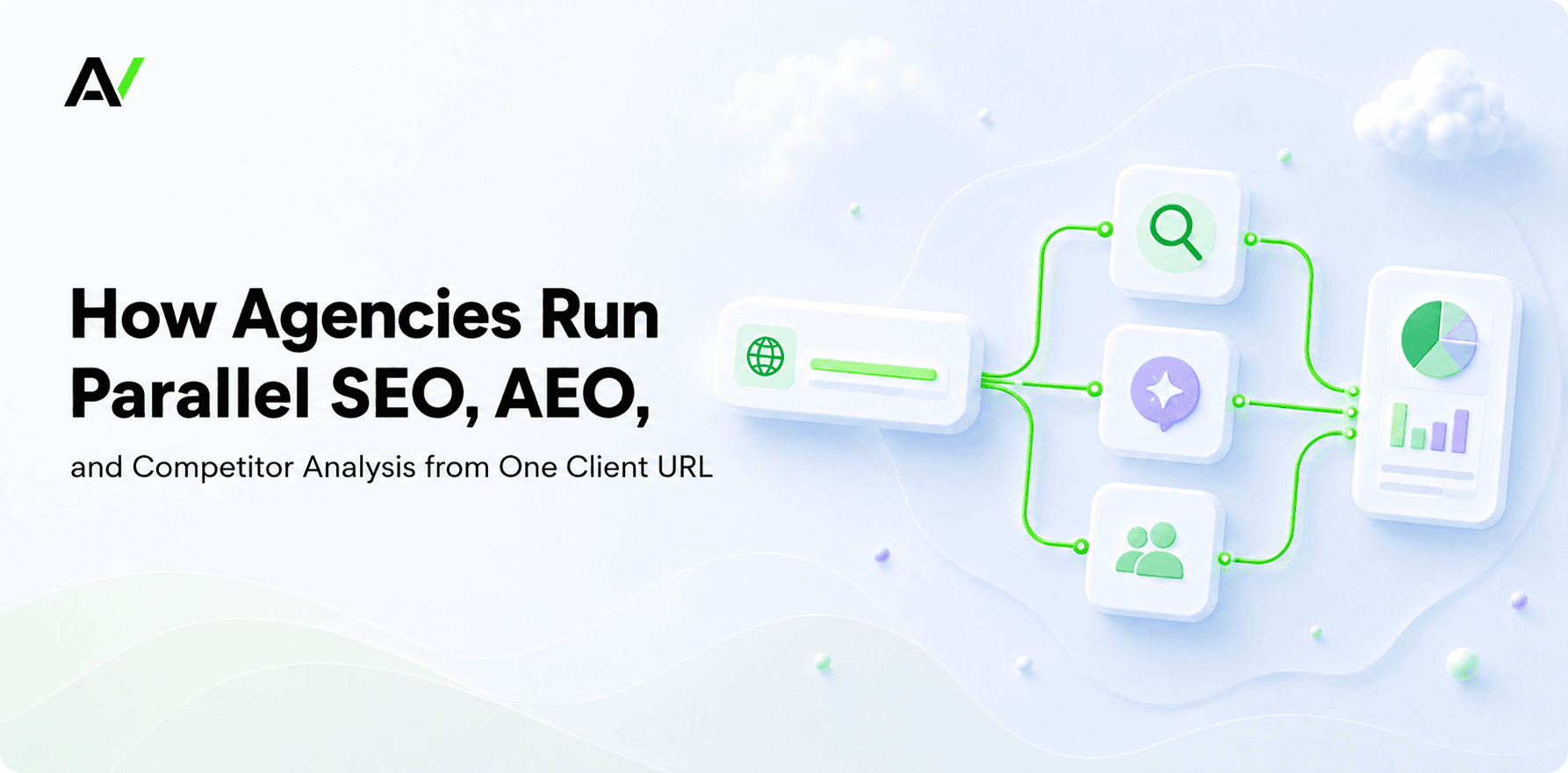
How Agencies Run Parallel SEO, AEO, and Competitor Analysis from One Client URL
How agencies can run SEO, AEO, competitor, social, and content analysis in parallel from one client URL - and turn the findings into scalable deliverables.
July 28, 2026 · 11 min read
On this page
Article · SEO/GEO
For many agencies, winning a new client is only the beginning of the work. Before the strategy can be presented, someone must review the website, check technical SEO, study competitors, analyze the content, examine local visibility, identify missing pages, assess social profiles, and decide what the client should prioritize. This process is often repeated manually for every small or medium-sized business account.
One team member checks titles and metadata. Another reviews competitors. Someone else creates a spreadsheet of content gaps. A strategist turns the findings into recommendations. A copywriter then translates those recommendations into page briefs, social ideas, or campaign concepts. By the time the audit reaches the client, the agency may have spent hours collecting information before producing anything directly usable.
A modern SEO & AEO audit changes that process. Instead of treating search optimization, AI visibility, competitor research, and content planning as separate projects, agencies can run them as parallel analysis workflows from one client URL. The outputs can then be connected inside a client workspace and converted into pages, briefs, tasks, calendars, and deliverables. The result is not simply a faster audit. It is a more scalable research-to-execution system.
Why traditional agency audits become difficult to scale
Manual audits work when an agency has a small number of high-value clients and enough specialists to support them. Problems appear when the agency needs to onboard multiple SMB clients at the same time. Each client may require:
- A technical website review
- Keyword and page analysis
- Competitor identification
- Local search research
- Social profile evaluation
- Content gap discovery
- Positioning recommendations
- A content calendar
- Page or article briefs
- A client-ready report
The work is repetitive, but it is not identical. A dental clinic requires local SEO, service pages, reviews, location signals, and patient FAQs. A SaaS company may need integration pages, comparison pages, use cases, product-led content, and stronger category positioning. A consulting firm may depend more heavily on expertise, trust signals, case studies, and thought leadership. This makes traditional templates difficult to use without significant customization.
Agencies commonly respond by combining several tools. They may use one platform for crawling, another for keyword research, a third for competitor analysis, a spreadsheet for content planning, and a document system for reporting. Each tool can provide valuable information. The operational problem is connecting the information.
A crawl may reveal that a service page has a weak title. A competitor review may show that competing firms have dedicated pages for that service. An AEO analysis may reveal that the website does not answer the most common buyer questions. A content strategist may then recommend a new page. When these findings live in separate tools, someone must connect them manually. That manual interpretation becomes the agency’s hidden scaling cost.
What is an SEO & AEO audit?
An SEO & AEO audit evaluates whether a business can be discovered, understood, trusted, and recommended across both traditional search engines and AI-powered answer systems.
SEO, or search engine optimization, focuses on improving visibility in search results. It includes technical health, crawlability, indexability, page structure, keyword relevance, internal linking, backlinks, local signals, and content quality. AEO, or answer engine optimization, focuses on making information easy for AI systems to interpret and use when generating answers. AEO analysis may examine:
- Whether the business is clearly defined
- Whether services and products are explained directly
- Whether important questions receive concise answers
- Whether claims are supported by proof
- Whether the website contains structured facts
- Whether comparison content is available
- Whether expertise and authority are visible
- Whether content can be easily extracted and summarized
- Whether schema and structured data support understanding
- Whether the company’s information is consistent across the web
SEO asks whether a page can rank. AEO asks whether an answer engine can understand, trust, cite, or recommend the business. For agencies, these should not be separate audits. They depend on many of the same inputs: website content, structure, entity information, authority signals, customer questions, and competitor positioning. Running them together creates a more complete visibility assessment.
Start with one client URL
The most efficient agency workflow begins with the client’s website URL. From that URL, the research system can identify the company’s positioning, services, products, locations, audiences, competitors, content themes, and existing visibility signals. The URL becomes the starting point for several specialized workflows. A discovery layer first builds a shared understanding of the business:
- What does the company offer?
- Who is the target customer?
- Which markets or locations does it serve?
- What makes the company different?
- What pages already exist?
- Which topics does the website emphasize?
- Which platforms or profiles are connected to the brand?
This business profile becomes shared context for the rest of the audit. Without this discovery layer, different specialists may reach different conclusions about the same company. The SEO reviewer may classify the company one way, while the competitor researcher selects businesses from a different category. Shared context keeps the analysis aligned. Once the business has been mapped, several agents or specialized workflows can begin working in parallel.
Run specialized analysis in parallel
A traditional audit is usually sequential. The agency reviews the website, passes findings to a strategist, asks someone to research competitors, and then waits for the content team to prepare recommendations. A multi-agent workflow can analyze several visibility layers at the same time.
SEO analysis
The SEO workflow reviews the website’s search readiness. It can examine page titles, meta descriptions, headings, internal links, indexability, crawlability, page depth, content relevance, structured data, thin pages, duplicated messaging, and missing search-focused pages. It should not only identify problems. It should explain their practical impact. For example:
“Three primary services are mentioned on the homepage, but none has a dedicated service page. This limits the website’s ability to rank for service-specific searches and makes internal linking more difficult.” That observation is more actionable than a generic warning about insufficient content.
AEO analysis
The AEO workflow evaluates whether AI answer engines can clearly understand the company. It looks for direct definitions, structured explanations, customer questions, service details, location information, proof, reviews, expert credentials, policies, comparisons, and factual consistency. For example:
“The website says the company delivers customized solutions but does not clearly define the types of businesses it serves, the problems it solves, or what is included in the service. An AI system may struggle to determine when the company should be recommended.” This analysis exposes a different kind of visibility gap. The website may be technically optimized while still being difficult to summarize.
Competitor analysis
The competitor workflow identifies businesses competing for the same customers, search terms, category positioning, or local visibility. It can compare:
- Page structures
- Service coverage
- Topic depth
- Positioning language
- FAQ content
- Review signals
- Comparison pages
- Case studies
- Local landing pages
- Social activity
- Calls to action
- Trust and authority signals
The goal is not to copy competitors. The goal is to determine why competitors may be easier to discover, understand, or trust. For example: “Two leading competitors have dedicated pages for implementation, pricing, integrations, and customer use cases. The client combines these topics on one general product page.” That finding can become a concrete website expansion plan.
Local and social analysis
For local service businesses, the audit should review Google Business Profile visibility, location consistency, reviews, local landing pages, service areas, and location-specific content. Social analysis can identify whether the company is active on the platforms where buyers research the category.
The question is not simply whether the client posts frequently. The audit should examine whether social profiles reinforce the same category, expertise, services, and proof presented on the website. A disconnected brand presence weakens both customer trust and machine understanding.
Content gap analysis
The content gap workflow combines findings from SEO, AEO, and competitors. It identifies what the client has not explained yet. Common gaps include:
- Missing service pages
- Weak product pages
- Unanswered customer questions
- No FAQ section
- Missing comparison pages
- Thin location pages
- No case studies
- Limited proof or reviews
- Missing integration content
- No category education
- Weak objection-handling content
- No content for high-intent buying stages
This is where parallel analysis becomes especially valuable. A missing page is rarely only an SEO problem. It may also affect AI visibility, sales clarity, internal linking, competitor differentiation, and conversion.
Merge findings into one prioritized intelligence layer
Parallel research can create a large volume of information. The agency still needs a system for deciding what matters. The next step is to merge findings, remove duplication, identify relationships, and prioritize recommendations. For example, separate workflows may produce the following observations:
- The homepage does not clearly define the main service.
- Competitors use dedicated service pages.
- AI systems may struggle to classify the company.
- Important commercial keywords do not have relevant landing pages.
- Social bios describe the company differently from the website.
These are not five unrelated issues. They point to one central problem: unclear positioning and service architecture. A merged recommendation could be: “Clarify the company’s primary category and build one dedicated page for each core service. Use the same category language across the homepage, service pages, schema, social bios, and business listings.” This is more useful than presenting the client with a long list of disconnected warnings.
A strong SEO & AEO audit should organize recommendations by business impact, not only by technical category. A practical prioritization model can include:
- Visibility impact
- Revenue relevance
- Implementation effort
- Dependency on other tasks
- Speed to value
This allows the agency to separate immediate corrections from longer-term growth initiatives.
Connect every audit to a client workspace
The report should not become the final destination for the research. Static reports often lose value after the client presentation. Recommendations remain inside a PDF while execution moves into project management tools, documents, spreadsheets, and message threads. A connected client workspace keeps the original intelligence linked to the work that follows. Each client workspace can contain:
- Business profile
- Audit findings
- Competitor summaries
- Priority recommendations
- Page inventory
- Content gaps
- Strategy documents
- Content calendars
- Tasks and owners
- Approval status
- Draft content
- Final deliverables
This creates continuity between analysis and execution. When a strategist creates a service page brief, the brief can reference the exact SEO gap, AEO issue, competitor example, and customer question that justified the page. When a client asks why a specific page is needed, the agency can show the underlying evidence.
Connected workspaces also make updates easier. If the client changes positioning, launches a new service, or enters a new market, the agency can update the shared business profile and use that information across future research and content workflows.
Turn intelligence into pages and briefs
An audit becomes valuable when findings are translated into specific work. Suppose the analysis shows that a local accounting firm has no dedicated pages for tax planning, bookkeeping, payroll, and business formation. Instead of stopping at “create more service pages,” the system can generate a page plan for each service. A useful page brief may include:
- Target customer
- Search intent
- Primary topic
- Supporting topics
- Customer questions
- Suggested title
- Recommended headings
- Proof to include
- Internal links
- Relevant calls to action
- Schema recommendations
- Competitor gaps to address
- Direct answers for AI extraction
This gives the content team a clearer starting point. The same intelligence can generate briefs for comparison pages, location pages, integration pages, FAQ hubs, case studies, educational articles, and landing pages. Because the briefs share the same client context, they are less likely to contradict one another.
Produce deliverables at scale
Agencies do not deliver only audits. They deliver presentations, roadmaps, page briefs, content calendars, social posts, website copy, campaign concepts, and monthly performance recommendations. A scalable workflow should allow one finding to support several outputs. For example, the finding “customers cannot easily understand how the product differs from spreadsheets” could become:
- A competitor comparison page
- A website positioning update
- A sales enablement document
- A LinkedIn post
- A short educational video
- A customer FAQ
- An email campaign
- A blog article
- A demo script
This is how agencies increase the value of their research. The initial audit becomes a reusable intelligence foundation rather than a one-time document.
Maintain human review and agency judgment
Automation should not remove the agency’s strategic role. Research systems can collect evidence, identify patterns, compare websites, organize findings, and generate initial recommendations. Human operators still need to review the outputs. Agency judgment is especially important when:
- Competitors serve different customer segments
- Search volume does not reflect commercial value
- The client has regulatory limitations
- Brand positioning is intentionally narrow
- A recommendation conflicts with the sales strategy
- The website contains outdated information
- Local market conditions require context
- The client cannot implement every recommendation at once
The strongest model combines specialized AI analysis with human approval. The system accelerates collection and synthesis. The agency decides what is strategically correct. This also allows agencies to maintain consistent quality while increasing the number of clients they can support.
A repeatable agency workflow
A practical agency process can follow seven stages:
- Submit the client URL - add the company website and any available business details.
- Build the business profile - confirm services, audiences, markets, positioning, locations, and goals.
- Run parallel analysis - launch SEO, AEO, competitor, local, social, and content gap workflows simultaneously.
- Merge and prioritize findings - connect related issues and rank recommendations by impact, effort, and revenue relevance.
- Create the client workspace - store findings, strategy, pages, briefs, tasks, and approvals in one connected environment.
- Generate execution assets - turn the research into page briefs, content plans, social concepts, website recommendations, and campaign deliverables.
- Review and present - apply agency judgment, refine recommendations, and present a clear roadmap to the client.
This workflow can be repeated across SaaS companies, consultants, ecommerce brands, professional services, local businesses, and growing SMBs. The analysis changes based on the company. The operational structure stays consistent.
Move from audit delivery to intelligence operations
Agencies do not need another tool that produces a longer list of warnings. They need a system that helps them understand a client faster, connect different visibility signals, decide what should happen next, and convert the findings into billable work. A parallel SEO & AEO audit makes this possible.
Starting with one client URL, specialized workflows can analyze search readiness, AI visibility, competitors, local presence, social signals, and content gaps at the same time. The findings can then be merged inside a connected workspace and transformed into pages, briefs, tasks, calendars, and client-ready deliverables.
This creates a better operating model for agencies. The client receives clearer priorities instead of disconnected scores. The agency spends less time repeating manual research. Strategists gain a shared source of truth. Content teams receive evidence-backed briefs. Account managers can explain why each recommendation matters. And the original audit remains useful long after the presentation is over.
ActVox is designed around this research-to-execution workflow. Agencies can begin with a client URL, run specialized marketing analysis, organize the findings inside a workspace, and turn the intelligence into practical work. The goal is not simply to complete audits faster. It is to build a repeatable system for delivering better marketing decisions at scale.
Next step
Put this to work on your business
For a business-specific version of this framework, run a free audit and get an actionable plan built from your real digital footprint.
Start my free auditRelated · Same topic
How to Check If Your Brand Appears in ChatGPT
A practical method to test, measure, and improve your brand’s visibility in ChatGPT search.
How to Build an AEO Strategy
A practical plan for making your brand easier for AI search to understand, cite, and recommend.
AI SEO Strategy: How AI Is Changing SEO in 2026
SEO did not disappear. Buyer discovery fragmented. Learn how to build an AI SEO strategy that earns visibility, trust, citations, and conversions.