Playbook · Social Media
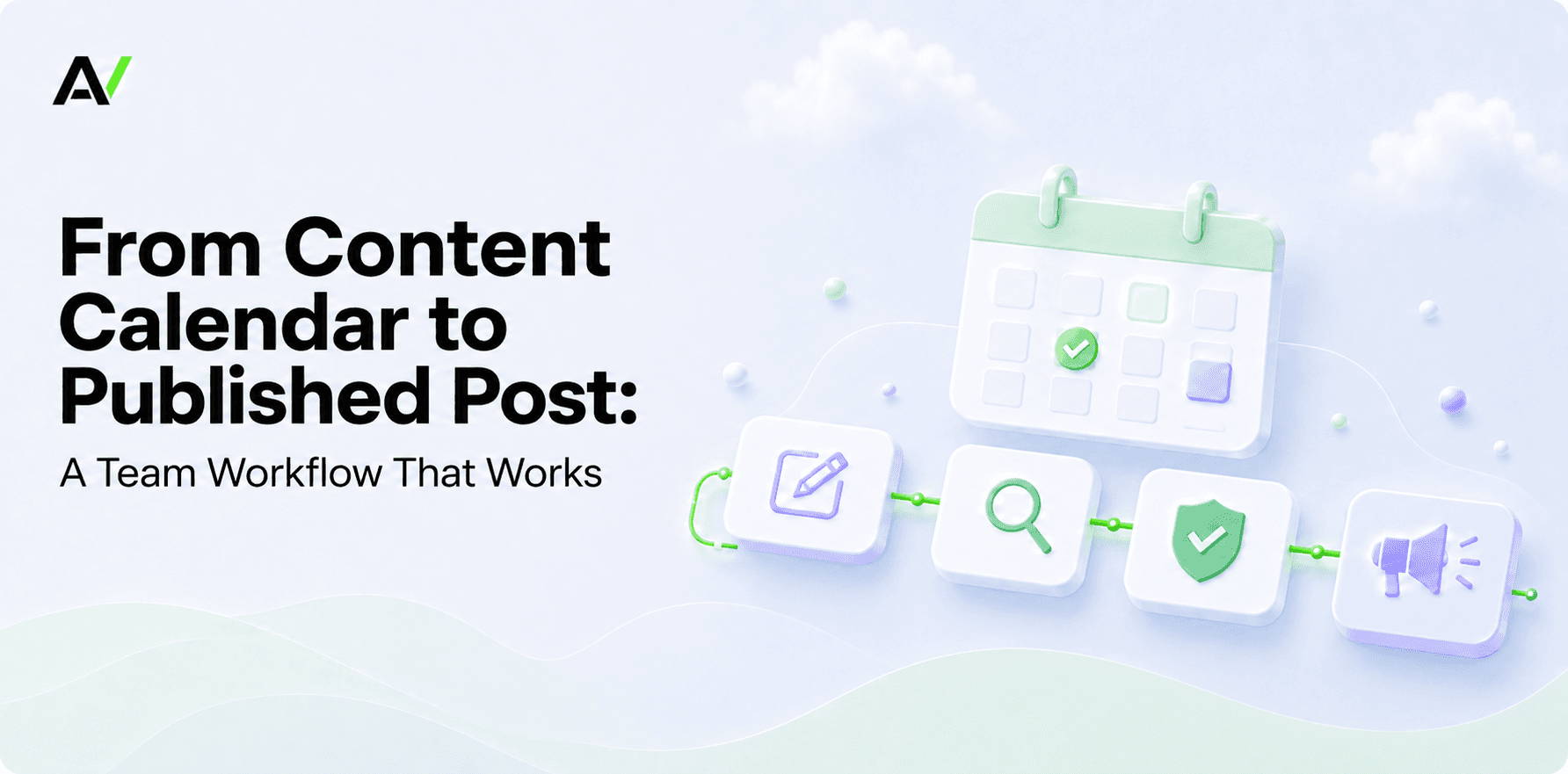
From Content Calendar to Published Post: A Team Workflow That Works
A practical method for building a realistic social media content calendar that connects campaigns, production capacity, approvals, and measurable business outcomes.
February 3, 2026 · 8 min read
On this page
Article · Social Media
A practical method for building a realistic social media content calendar that connects campaigns, production capacity, approvals, and measurable business outcomes.
Every marketing team has created the beautiful calendar: color-coded campaigns, a post for every weekday, and carefully balanced themes for LinkedIn, Instagram, X, TikTok, and Facebook.
Then the calendar goes quiet by week three.
The problem is rarely a lack of ideas. The problem is that most social media calendars describe what the team hopes to publish without defining how the work will move from idea to approved asset.
A social calendar that ships is a different kind of system. It reflects the team’s actual capacity, connects every post to a campaign, includes the information needed to create the content, and reserves time for review. When something slips, the team follows a rule instead of abandoning the plan.
Here is how to build a social media content calendar your team can execute consistently.
Why most social media content calendars fail
Content Marketing Institute found that 45% of B2B marketers lacked a scalable model for content creation. Only 29% described their content strategy as very or extremely effective. The strongest performers were more likely to connect their goals to organizational objectives, measure results effectively, and use a scalable production model. Content Marketing Institute (https://contentmarketinginstitute.com/b2b-research/b2b-content-marketing-trends-research-2025)
That distinction matters. A content strategy explains what the brand wants to communicate and why. A social media calendar should turn that strategy into assigned, reviewable, publishable work.
Most calendars fail because they contain dates and topics but omit the operating details:
- Cadence is based on ambition rather than demonstrated capacity.
- Entries say “LinkedIn post” without defining the argument.
- Every platform is treated as equally important.
- Source material is missing when drafting begins.
- Review and approval are not scheduled.
- Ownership is unclear.
- Missed posts quietly disappear.
- Performance is evaluated through likes rather than business outcomes.
These are workflow design problems, not creativity problems.
Content operations research describes three foundations of an effective system: people, processes, and technology. A calendar becomes useful only when it connects all three. Content Marketing Institute (https://contentmarketinginstitute.com/content-operations/master-content-operations)
1. Start with business outcomes
Before choosing posting dates, decide what the business needs social media to accomplish.
A useful social media content strategy might support:
- Brand awareness in a specific market
- Demand generation for a product or service
- Product education
- Lead generation
- Event registrations
- Customer retention
- Category positioning
- Recruitment
- Community participation
Avoid combining every objective in one monthly social media plan. Choose one primary outcome and one or two supporting outcomes.
For example:
> Primary outcome: Help small-business founders understand why AI search visibility matters. > Supporting outcome: Generate registrations for a free visibility audit.
This decision gives the calendar direction. It also makes social media performance easier to measure because every campaign has a defined job.
2. Build the cadence around actual capacity
The best posting schedule is not the most aggressive schedule. It is the schedule your team can sustain while maintaining quality.
Review the previous eight weeks and calculate:
- Posts planned
- Posts completed
- Posts published on time
- Assets requiring design or video
- Average review time
- Weeks disrupted by launches, events, or other priorities
If your team shipped an average of six posts per week, do not build a calendar that requires fifteen. Begin with four or five committed posts and add several stretch slots.
Use two levels of publishing:
Committed content: Posts that must ship because they support active campaigns or important business outcomes.
Stretch content: Timely reactions, experimental formats, community posts, or extra adaptations that ship when capacity allows.
This creates a realistic content calendar for a small marketing team. The committed tier protects consistency; the stretch tier absorbs unpredictable work.
3. Plan campaigns before dates
A date-first calendar asks, “What should we publish on Tuesday?”
A campaign-based content calendar asks, “What does our audience need to understand this month?”
The second question produces stronger content.
Start with two or three monthly campaign themes. Each campaign should come from evidence such as:
- Customer questions
- Sales objections
- Search and social listening data
- Competitor content gaps
- Website or SEO audits
- Product releases
- Industry research
- Community conversations
Sprout Social’s 2025 research, based on more than 4,000 consumers and over 1,200 marketers and marketing leaders, found that relevance requires understanding the context of cultural conversations-not recreating every popular meme. Sprout Social (https://sproutsocial.com/insights/index/)
Campaign planning gives teams that context. It also makes content repurposing systematic.
One anchor article, report, webinar, or customer story can produce:
- A LinkedIn thought-leadership post
- An Instagram carousel
- A short-form video
- An X thread
- A customer quote graphic
- A poll or discussion prompt
- A follow-up post responding to audience questions
The calendar should show how those assets support one campaign rather than presenting them as unrelated posts.
4. Make every calendar entry execution-ready
A slot labeled “Instagram - marketing tips” is not a task. It is a reminder that someone still needs to plan the task.
Every entry in a team content calendar should include:
- Campaign: What larger initiative does this support?
- Audience: Who should care about it?
- Angle: What is the central claim or question?
- Source: Which report, article, customer insight, or product information supports it?
- Platform: Where will it be published?
- Format: Text post, carousel, short video, poll, thread, or graphic
- Call to action: What should the reader do next?
- Owner: Who is responsible for completing it?
- Reviewer: Who approves it?
- Status: Planned, drafting, designing, in review, approved, scheduled, or published
- Deadline: When must the draft be ready-not only when must it publish?
Documented editorial workflows clarify responsibilities and show how content moves from ideation through drafting, editing, approval, and publication. They should also indicate the expected time for each stage. Content Marketing Institute (https://contentmarketinginstitute.com/content-operations/content-governance-successful-strategy)
Completing these fields during social media planning takes a few minutes. Leaving them empty converts every production day into another planning session.
5. Schedule review before publication
If publishing is scheduled but review is not, approval becomes the default bottleneck.
Create a recurring content approval workflow. For example:
- Monday: Campaign priorities confirmed
- Tuesday: Drafts and creative briefs completed
- Wednesday: Design and video production
- Thursday: Batch review for the following week
- Friday: Revisions, approval, and social media scheduling
Add a clear approval rule. If a reviewer does not respond within the agreed window, the content owner should either publish using established brand guidelines or move the post to a named future date.
Silence should never function as an indefinite veto.
Batching review also gives the reviewer campaign context. Instead of responding to isolated assets throughout the week, they can evaluate whether the complete sequence is accurate, consistent, and aligned with the business objective.
6. Handle missed posts by rule
Content will occasionally slip. The goal is not to eliminate every miss but to prevent one missed slot from making the entire social media calendar unreliable.
Every missed post must receive one of three outcomes:
- Rescheduled to a specific date
- Combined with another planned asset
- Dropped with a short explanation
Never leave a missed entry sitting in the calendar without a decision. Silent gaps teach the team that deadlines and statuses are optional.
7. Measure the calendar as an operating system
Do not judge a social media content calendar only by impressions or engagement. Measure both production reliability and marketing performance.
Track these social media calendar metrics monthly:
- Metric: Ship rate; What it reveals: Published posts ÷ committed posts
- Metric: On-time rate; What it reveals: Posts published on schedule ÷ published posts
- Metric: Approval time; What it reveals: Average time from review request to decision
- Metric: Revision rate; What it reveals: Percentage of assets requiring major changes
- Metric: Repurposing ratio; What it reveals: Platform assets created from each anchor asset
- Metric: Campaign contribution; What it reveals: Leads, sign-ups, visits, mentions, or other campaign outcomes
- Metric: Qualified engagement; What it reveals: Comments, saves, replies, profile visits, and conversations from the target audience
A high-engagement post that attracts the wrong audience may be less valuable than a lower-reach post that generates qualified conversations.
Review operational metrics monthly. Revisit channels, campaign priorities, and posting cadence quarterly.
A realistic weekly social media calendar
For a three-person marketing team, a sustainable week might look like this:
- Monday: LinkedIn post introducing the campaign’s main argument
- Tuesday: Instagram carousel explaining the framework
- Wednesday: Community engagement and comment responses
- Thursday: Short video or product demonstration
- Friday: Customer example, proof point, or campaign call to action
The same core idea can travel across platforms, but the execution should match each platform. A LinkedIn argument should not simply be pasted into an Instagram caption, and a detailed article should not be read word-for-word as a TikTok script.
Where AI should-and should not-help
AI can make social media workflow management faster by:
- Summarizing research
- Generating draft variations
- Turning articles into platform-specific briefs
- Suggesting repurposing opportunities
- Checking brand and campaign alignment
- Producing first-draft captions
- Organizing performance insights
However, AI should not decide the brand’s point of view, invent supporting evidence, or automatically approve sensitive claims. Human review remains essential for accuracy, relevance, tone, and strategic judgment.
The useful shift is not from human-created content to fully automated content. It is from disconnected prompts to a repeatable research, creation, review, publishing, and learning loop.
Build a calendar that represents real work
A successful social media calendar is not a decorative scheduling document. It is an operating agreement about what the team will publish, why it matters, who owns it, and how it gets approved.
Keep the cadence honest. Organize content around campaigns. Attach evidence and briefs to every entry. Schedule the review lane. Make missed posts visible. Measure whether the system ships as well as whether the content performs.
ActVox helps connect these stages. It analyzes a business’s SEO, AI search visibility, competitors, social presence, and content gaps, then turns those findings into campaign themes, content ideas, briefs, and an execution-ready marketing workspace.
Put this framework to work for your business
Build a business-specific social media content calendar using evidence from your actual website, competitors, market, and digital footprint.
Next step
Put this to work on your business
For a business-specific version of this framework, run a free audit and get an actionable plan built from your real digital footprint.
Start my free auditRelated · Same topic

How to Create AI Instagram Carousels That People Want to Save
A practical guide for freelance marketers who want to create useful content faster without sounding generic.
SEO and Social Media Strategy: Build a Content System That Compounds
Learn how to connect SEO and social media into a repeatable content system that increases reach, improves distribution, and compounds organic traffic.